
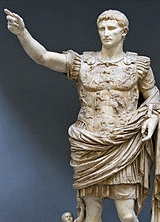
The Roman Empire was the post-
RepublicanThe Roman Republic was the period of the ancient Roman civilization where the government operated as a republic. It began with the overthrow of the Roman monarchy, traditionally dated around 508 BC, and its replacement by a government headed by two consuls, elected annually by the citizens and...
period of the
ancient Roman civilizationAncient Rome was a thriving civilization that grew on the Italian Peninsula as early as the 8th century BC. Located along the Mediterranean Sea and centered on the city of Rome, it expanded to one of the largest empires in the ancient world....
, characterised by an
autocraticAn autocracy is a form of government in which one person is the supreme power within the state. It is derived from the Greek : and , and may be translated as "one who rules by himself". It is distinct from oligarchy and democracy...
form of government and large territorial holdings in Europe and around the Mediterranean.
The 500-year-old
Roman RepublicThe Roman Republic was the period of the ancient Roman civilization where the government operated as a republic. It began with the overthrow of the Roman monarchy, traditionally dated around 508 BC, and its replacement by a government headed by two consuls, elected annually by the citizens and...
, which preceded it, had been weakened and
subvertedSubversion refers to an attempt to transform the established social order, its structures of power, authority, and hierarchy; examples of such structures include the State. In this context, a "subversive" is sometimes called a "traitor" with respect to the government in-power. A subversive is...
through several
civil warsThere were several Roman civil wars, especially during the late Republic. The most famous of these are the war in the 40s BC between Julius Caesar and the optimate faction of the senatorial elite initially led by Pompey and the subsequent war between Caesar's successors, Octavian and Mark Antony in...
. Several events are commonly proposed to mark the transition from Republic to Empire, including
Julius CaesarGaius Julius Caesar was a Roman general and statesman and a distinguished writer of Latin prose. He played a critical role in the gradual transformation of the Roman Republic into the Roman Empire....
's appointment as perpetual
dictatorIn the Roman Republic, the dictator , was an extraordinary magistrate with the absolute authority to perform tasks beyond the authority of the ordinary magistrate . The office of dictator was a legal innovation originally named Magister Populi , i.e...
(44 BC), the
Battle of ActiumThe Battle of Actium was the decisive confrontation of the Final War of the Roman Republic. It was fought between the forces of Octavian and the combined forces of Mark Antony and Cleopatra VII. The battle took place on 2 September 31 BC, on the Ionian Sea near the city of Actium, at the Roman...
( 31 BC), and the Roman Senate's granting to Octavian the
honorificAn honorific is a word or expression with connotations conveying esteem or respect when used in addressing or referring to a person. Sometimes, the term is used not quite correctly to refer to an honorary title...
AugustusAugustus , Latin for "majestic," "the increaser," or "venerable", was an Ancient Roman title, which was first held by Gaius Julius Caesar Augustus , and subsequently came to be considered one of the titles of what are now known as the Roman Emperors...
( 27 BC).
Roman expansion began in the days of the Republic, but the Empire reached its greatest extent under Emperor
TrajanTrajan , was Roman Emperor from 98 to 117 AD. Born into a non-patrician family in the province of Hispania Baetica, in Spain Trajan rose to prominence during the reign of emperor Domitian. Serving as a legatus legionis in Hispania Tarraconensis, in Spain, in 89 Trajan supported the emperor against...
: during his reign (98 to 117 AD) the Roman Empire controlled approximately km
2 of land surface. Because of the Empire's vast extent and long endurance, the institutions and culture of Rome had a profound and lasting influence on the development of language, religion, architecture, philosophy, law, and forms of government in the territory it governed, particularly Europe, and by means of European expansionism throughout the modern world.
In the late 3rd century AD,
DiocletianDiocletian |latinized]] upon his accession to Diocletian . c. 22 December 244 – 3 December 311), was a Roman Emperor from 284 to 305....
established the practice of dividing authority between four co-emperors, in order to better secure the vast territory, putting an end to the
Crisis of the Third CenturyThe Crisis of the Third Century was a period in which the Roman Empire nearly collapsed under the combined pressures of invasion, civil war, plague, and economic depression...
. During the following decades the Empire was often divided along an East/West axis. After the death of Theodosius I in 395 it was divided for the last time.
The
Western Roman EmpireThe Western Roman Empire was the western half of the Roman Empire after its division by Diocletian in 285; the other half of the Roman Empire was the Eastern Roman Empire, commonly referred to today as the Byzantine Empire....
collapsed in 476 as Romulus Augustus was forced to abdicate to the
GermanicThe Germanic peoples are an Indo-European ethno-linguistic group of Northern European origin, identified by their use of the Indo-European Germanic languages which diversified out of Proto-Germanic during the Pre-Roman Iron Age.Originating about 1800 BCE from the Corded Ware Culture on the North...
warlord
OdoacerFlavius Odoacer , also known as Flavius Odovacer, was the first King of Italy. His reign is commonly seen as marking the end of the Western Roman Empire. Though the real power in Italy was in his hands, he represented himself as the client of Julius Nepos and, after Nepos' death in 480, of the...
. The Eastern Roman or
Byzantine EmpireThe Byzantine Empire was the Eastern Roman Empire during the periods of Late Antiquity and the Middle Ages, centred on the capital of Constantinople. Known simply as the Roman Empire or Romania to its inhabitants and neighbours, the Empire was the direct continuation of the Ancient Roman State...
ended in 1453 with the death of Constantine XI and the
capture of ConstantinopleThe Fall of Constantinople was the capture of the capital of the Byzantine Empire, which occurred after a siege by the Ottoman Empire, under the command of Ottoman Sultan Mehmed II, against the defending army commanded by Byzantine Emperor Constantine XI...
by the
Ottoman TurksThe Ottoman Turks were the Turkish-speaking population of the Ottoman Empire who formed the base of the state's military and ruling classes. Reliable information about the early history of Ottoman Turks is scarce, but they take their Turkish name, Osmanlı , from the house of Osman I The Ottoman...
led by Mehmed II.
Government
Emperor
The powers of an emperor (his
imperiumImperium is a Latin word which, in a broad sense, translates roughly as 'power to command'. In ancient Rome, different kinds of power or authority were distinguished by different terms. Imperium, referred to the sovereignty of the state over the individual...
) existed, in theory at least, by virtue of his "tribunician powers" (potestas tribunicia) and his "proconsular powers" (imperium proconsulare). In theory, the tribunician powers (which were similar to those of the Plebeian Tribunes under the old republic) made the Emperor's person and office sacrosanct, and gave the Emperor authority over Rome's civil government, including the power to preside over and to control the Senate.
The proconsular powers (similar to those of military governors, or
ProconsulA proconsul was a governor of a province in the Roman Republic appointed for one year by the senate. In modern usage, the title has been used for a person from one country ruling another country or bluntly interfering in another country's internal affairs.-Ancient Rome:In the Roman Republic, a...
s, under the old Republic) gave him authority over the Roman army. He was also given powers that, under the Republic, had been reserved for the
SenateThe Senate of the Roman Republic was a political institution in the ancient Roman Republic, however, it was not an elected body, but one whose members were appointed by the consuls, and later by the censors. After a magistrate served his term in office, it usually was followed with automatic...
and the
assembliesThe Legislative Assemblies of the Roman Republic were political institutions in the ancient Roman Republic. According to the contemporary historian Polybius, it was the people who had the final say regarding the election of magistrates, the enactment of new statutes, the carrying out of capital...
, including the right to declare war, to ratify treaties, and to negotiate with foreign leaders.
The emperor also had the authority to carry out a range of duties that had been performed by the censors, including the power to control Senate membership. In addition, the emperor controlled the
religious institutionsReligion in ancient Rome encompassed the religious beliefs and cult practices regarded by the Romans as indigenous and central to their identity as a people, as well as the various and many cults imported from other peoples brought under Roman rule. Romans thus offered cult to innumerable deities...
, since, as emperor, he was always
Pontifex MaximusThe Pontifex Maximus was the high priest of the College of Pontiffs in ancient Rome. This was the most important position in the ancient Roman religion, open only to patricians until 254 BC, when a plebeian first occupied this post...
and a member of each of the four major priesthoods. While these distinctions were clearly defined during the early Empire, eventually they were lost, and the emperor's powers became less constitutional and more monarchical.
Realistically, the main support of an emperor's power and authority was the military. Being paid by the imperial treasury, the legionaries also swore an annual military oath of loyalty towards him, called the Sacramentum.
The death of an emperor led to a crucial period of uncertainty and crisis. In theory the Senate was entitled to choose the new emperor, but most emperors chose their own successors, usually a close family member. The new emperor had to seek a swift acknowledgement of his new status and authority in order to stabilize the political landscape. No emperor could hope to survive, much less to reign, without the allegiance and loyalty of the
Praetorian GuardThe Praetorian Guard was a force of bodyguards used by Roman Emperors. The title was already used during the Roman Republic for the guards of Roman generals, at least since the rise to prominence of the Scipio family around 275 BC...
and of the legions. To secure their loyalty, several emperors paid the
donativumDonativum was the name given to the gifts of money dispersed to the soldiers of the Roman legions or to the Praetorian Guard by the Roman Emperors....
, a monetary reward.
Senate
While the
Roman assembliesThe Legislative Assemblies of the Roman Empire were political institutions in the ancient Roman Empire. During the reign of the second Roman Emperor, Tiberius, the powers that had been held by the Roman assemblies were transferred to the senate...
continued to meet after the founding of the Empire, their powers were all transferred to the
Roman SenateThe Senate of the Roman Republic was a political institution in the ancient Roman Republic, however, it was not an elected body, but one whose members were appointed by the consuls, and later by the censors. After a magistrate served his term in office, it usually was followed with automatic...
, and so senatorial decrees (senatus consulta) acquired the full force of law.
In theory, the Emperor and the Senate were two equal branches of government, but the actual authority of the Senate was negligible and it was largely a vehicle through which the Emperor disguised his autocratic powers under a cloak of republicanism. Although the Senate still commanded much prestige and respect, it was largely a glorified
rubber stampA rubber stamp, as a political metaphor, refers to a person or institution with considerable de jure power but little de facto power; one that rarely disagrees with more powerful organs....
institution. Stripped of most of its powers, the Senate was largely at the Emperor's mercy.
Many emperors showed a certain degree of respect towards this ancient institution, while others were notorious for ridiculing it. During Senate meetings, the Emperor sat between the two
consulsA consul served in the highest elected political office of the Roman Republic.Each year, two consuls were elected together, to serve for a one-year term. Each consul was given veto power over his colleague and the officials would alternate each month...
, and usually acted as the presiding officer. Higher ranking senators spoke before lower ranking senators, although the Emperor could speak at any time. By the 3rd century, the Senate had been reduced to a glorified municipal body.
Senators and equestrians
No emperor could rule the Empire without the Senatorial order and the Equestrian order. Most of the more important posts and offices of the government were reserved for the members of these two aristocratic orders. It was from among their ranks that the provincial governors, legion commanders, and similar officials were chosen.
These two classes were hereditary and mostly closed to outsiders. Very successful and favoured individuals could enter, but this was a rare occurrence. The career of a young aristocrat was influenced by his family connections and the favour of patrons. As important as ability, knowledge, skill, or competence, patronage was considered vital for a successful career and the highest posts and offices required the Emperor's favour and trust.
Senatorial order
The son of a senator was expected to follow the
Cursus honorumThe cursus honorum was the sequential order of public offices held by aspiring politicians in both the Roman Republic and the early Empire. It was designed for men of senatorial rank. The cursus honorum comprised a mixture of military and political administration posts. Each office had a minimum...
, a
career ladderThe term "career ladder" is a metaphor or buzzword used to denote vertical job promotion. In business and human resources management, the ladder typically describes the progression from entry level positions to higher levels of pay, skill, responsibility, or authority. This metaphor is spatially...
, and the more prestigious positions were restricted to senators only. A senator also had to be wealthy; one of the basic requirements was the wealth of 12,000 gold
aureiThe aureus was a gold coin of ancient Rome valued at 25 silver denarii. The aureus was regularly issued from the 1st century BC to the beginning of the 4th century, when it was replaced by the solidus...
(about 100 kg of gold), a figure which would later be raised with the passing of centuries.
Equestrian order
Below the Senatorial order was the Equestrian order. The requirements and posts reserved for this class, while perhaps not so prestigious, were still very important. Some of the more vital posts, like the governorship of Egypt (Latin Aegyptus), were even forbidden to the members of the Senatorial order and available only to equestrians.
Military
Legions
During and after the civil war, Octavian reduced the huge number of the
legionsA Roman legion normally indicates the basic ancient Roman army unit recruited specifically from Roman citizens. The organization of legions varied greatly over time but they were typically composed of perhaps 5,000 soldiers, divided into maniples and later into "cohorts"...
(over 60) to a much more manageable and affordable size (28). Several legions, particularly those with doubtful loyalties, were simply disbanded. Other legions were amalgamated, a fact suggested by the title Gemina (Twin).
In AD 9, Germanic tribes wiped out three full legions in the
Battle of the Teutoburg ForestThe Battle of the Teutoburg Forest took place in 9 CE, when an alliance of Germanic tribes led by Arminius of the Cherusci ambushed and decisively destroyed three Roman legions, along with their auxiliaries, led by Publius Quinctilius Varus.Despite numerous successful campaigns and raids by the...
. This disastrous event reduced the number of the legions to 25. The total of the legions would later be increased again and for the next 300 years always be a little above or below 30.
Augustus also created the
Praetorian GuardThe Praetorian Guard was a force of bodyguards used by Roman Emperors. The title was already used during the Roman Republic for the guards of Roman generals, at least since the rise to prominence of the Scipio family around 275 BC...
: nine
cohortsA cohort was the basic tactical unit of a Roman legion following the reforms of Gaius Marius in 107 BC.-Legionary cohort:...
ostensibly to maintain the public peace which were garrisoned in Italy. Better paid than the legionaries, the Praetorians also served less time; instead of serving the standard 25 years of the legionaries, they retired after 16 years of service.
Auxilia
While the
auxiliaAuxiliaries formed the standing non-citizen corps of the Roman army of the Principate , alongside the citizen legions...
(Latin: auxilia = supports) are not as famous as the legionaries, they were of major importance. Unlike the legionaries, the auxilia were recruited from among the non-citizens. Organized in smaller units of roughly cohort strength, they were paid less than the legionaries, and after 25 years of service were rewarded with
Roman citizenshipCitizenship in ancient Rome was a privileged political and legal status afforded to certain free-born individuals with respect to laws, property, and governance....
, also extended to their sons. According to
TacitusPublius Cornelius Tacitus was a senator and a historian of the Roman Empire. The surviving portions of his two major works—the Annals and the Histories—examine the reigns of the Roman Emperors Tiberius, Claudius, Nero and those who reigned in the Year of the Four Emperors...
there were roughly as many auxiliaries as there were legionaries. Since at this time there were 25 legions of around 5,000 men each, the auxilia thus amounted to around 125,000 men, implying approximately 250 auxiliary regiments.
Navy
The
Roman navyThe Roman Navy comprised the naval forces of the Ancient Roman state. Although the navy was instrumental in the Roman conquest of the Mediterranean basin, it never enjoyed the prestige of the Roman legions...
(Latin: Classis, lit. "fleet") not only aided in the supply and transport of the legions, but also helped in the protection of the frontiers in the rivers
Rhine and
DanubeThe Danube is a river in the Central Europe and the Europe's second longest river after the Volga. It is classified as an international waterway....
. Another of its duties was the protection of the very important maritime trade routes against the threat of pirates. Therefore it patrolled the whole of the Mediterranean, parts of the North Atlantic (coasts of Hispania, Gaul, and Britannia), and had also a naval presence in the
Black SeaThe Black Sea is bounded by Europe, Anatolia and the Caucasus and is ultimately connected to the Atlantic Ocean via the Mediterranean and the Aegean seas and various straits. The Bosphorus strait connects it to the Sea of Marmara, and the strait of the Dardanelles connects that sea to the Aegean...
. Nevertheless the army was considered the senior and more prestigious branch.
Provinces
Until the
TetrarchyThe term Tetrarchy describes any system of government where power is divided among four individuals, but usually refers to the tetrarchy instituted by Roman Emperor Diocletian in 293, marking the end of the Crisis of the Third Century and the recovery of the Roman Empire...
(296 AD) Roman provinces (lat. provincae) were administrative and territorial units of the Roman Empire outside of Italy.
In the old days of the Republic the governorships of the provinces were traditionally awarded to members of the Senatorial Order. Augustus' reforms changed this policy.
Imperial provinces
Augustus created the
Imperial provinceAn imperial province was a Roman province where the Emperor had the sole right to appoint the governor . These provinces were often the strategically located border provinces....
s. Most, but not all, of the Imperial provinces were relatively recent conquests and located at the borders. Thereby the overwhelming majority of legions, which were stationed at the frontiers, were under direct Imperial control. Very important was the Imperial province of Egypt, the major
breadbasketThe breadbasket or the granary of a country is a region which, because of richness of soil and/or advantageous climate, produces an agricultural surplus which is often considered vital for the country as a whole. Rice bowl is a similar term used in Southeast Asia...
of the Empire, whose
grain supplyIn classical antiquity, the grain supply to the city of Rome could not be met entirely from the surrounding countryside, which was taken up by the villas and parks of the aristocracy and which produced mainly fruit, vegetables and other perishable goods...
was vital to feed the masses in Rome. It was considered the personal fiefdom of the Emperor, and Senators were forbidden to even visit this province. The governor of Egypt and the commanders of any legion stationed there were not from the Senatorial Order, but were chosen by the Emperor from among the members of the lower Equestrian Order.
Senatorial provinces
The old traditional policy continued largely unchanged in the
Senatorial provinceA senatorial province was a Roman province where the Roman Senate had the right to appoint the governor . These provinces were away from the Empire's borders and free from the likelihood of rebellion, and so had few if any legions stationed in them...
s. Due to their location, away from the borders, and to the fact that they were under longer Roman sovereignty and control, these provinces were largely peaceful and stable. Only a single legion was based in a Senatorial province: Legio III Augusta, stationed in the Senatorial province of
AfricaThe Roman province of Africa was established after the Romans defeated Carthage in the Third Punic War. It roughly comprised the territory of present-day northern Tunisia, and the small Mediterranean coast of modern-day western Libya along the Syrtis Minor...
(modern northern Algeria).
The status of a province was subject to change; it could change from Senatorial towards Imperial, or vice-versa. This happened several times during Augustus' reign. Another trend was to create new provinces, mostly by dividing older ones, or by expanding the Empire.
Religion
As the Empire expanded, and came to include people from a variety of cultures, the worship of an ever increasing number of
deitiesA deity is a recognized preternatural or supernatural immortal being, who may be thought of as holy, divine, or sacred, held in high regard, and respected by believers....
was tolerated and accepted. The Imperial government, and the Romans in general, tended to be very tolerant towards most religions and cults, so long as they did not cause trouble. This could easily be accepted by other faiths as Roman liturgy and ceremonies were frequently tailored to fit local culture and identity.
An individual could attend to both the Roman gods representing his Roman identity and his own personal faith, which was considered part of his personal identity. There were periodic persecutions of various religions at various points in time, most notably that of Christians. As the historian
Edward GibbonEdward Gibbon was an English historian and Member of Parliament...
noted, however, most of the recorded histories of Christian persecutions come to us through the Christian church, which had an incentive to exaggerate the degree to which the persecutions occurred. The non-Christian contemporary sources only mention the persecutions passingly and without assigning great importance to them.
Imperial cult
In an effort to enhance loyalty, the inhabitants of the Empire were called to participate in the
Imperial cultThe Imperial cult of ancient Rome identified emperors and some members of their families with the divinely sanctioned authority of the Roman State...
to revere (usually deceased) emperors as
demigodThe term "demigod" , meaning "half-god", is commonly used to describe mythological figures whose one parent was a god and whose other parent was human; as such, demigods are human-god hybrids...
s. Few emperors claimed to be Gods while living, with the few exceptions being emperors who were widely regarded at the time to be insane (such as
CaligulaCaligula , also known as Gaius, was Roman Emperor from 37 AD to 41 AD. Caligula was a member of the house of rulers conventionally known as the Julio-Claudian dynasty. Caligula's father Germanicus, the nephew and adopted son of Emperor Tiberius, was a very successful general and one of Rome's most...
). Doing so in the early Empire would have risked revealing the shallowness of what the Emperor
AugustusAugustus ;23 September 63 BC – 19 August AD 14) is considered the first emperor of the Roman Empire, which he ruled alone from 27 BC until his death in 14 AD.The dates of his rule are contemporary dates; Augustus lived under two calendars, the Roman Republican until 45 BC, and the Julian...
called the "restored Republic" and would have had a decidedly eastern quality to it. Since the tool was mostly one the Emperor used to control his subjects, its usefulness would have been greatest in the chaotic later Empire, when the emperors were often Christians and unwilling to participate in the practice.
Usually, an emperor was deified after his death by his successor in an attempt by that successor to enhance his own prestige. This practice can be misunderstood, however, since "deification" was to the ancient world what canonization is to the Christian world. Likewise, the term "god" had a different context in the ancient world. This could be seen during the years of the
Roman RepublicThe Roman Republic was the period of the ancient Roman civilization where the government operated as a republic. It began with the overthrow of the Roman monarchy, traditionally dated around 508 BC, and its replacement by a government headed by two consuls, elected annually by the citizens and...
with religio-political practices such as the disbanding of a Senate session if it was believed the gods disapproved of the session or wished a particular vote. Deification was one of the many honors a dead emperor was entitled to, as the Romans (more than modern societies) placed great prestige on honors and national recognitions.
The importance of the Imperial cult slowly grew, reaching its peak during the
Crisis of the Third CenturyThe Crisis of the Third Century was a period in which the Roman Empire nearly collapsed under the combined pressures of invasion, civil war, plague, and economic depression...
. Especially in the eastern half of the Empire, imperial cults grew very popular. As such it was one of the major agents of
romanizationRomanization or latinization indicate different historical processes, such as acculturation, integration and assimilation of newly incorporated and peripheral populations by the Roman Republic and the later Roman Empire...
. The central elements of the cult complex were next to a temple; a
theatreThe characteristics of Roman to those of the earlier Greek theatres due in large part to its influence on the Roman triumvir Gnaeus Pompeius Magnus. Much of the architectural influence on the Romans came from the Greeks, and theatre structural design was no different from other buildings...
or
amphitheatreAn amphitheatre is an open-air venue used for entertainment and performances.There are two similar, but distinct, types of structure for which the word "amphitheatre" is used: Ancient Roman amphitheatres were large central performance spaces surrounded by ascending seating, and were commonly used...
for gladiator displays and other games and a
public bath complexIn ancient Rome, thermae and balnea were facilities for bathing...
. Sometimes the imperial cult was added to the cults of an existing temple or celebrated in a special hall in the bath complex.
The seriousness of this belief is unclear. Some Romans ridiculed the notion that a Roman emperor was to be considered a living god, or would even make fun of the deification of an emperor after his death.
Seneca the YoungerLucius Annaeus Seneca was a Roman Stoic philosopher, statesman, dramatist, and in one work humorist, of the Silver Age of Latin literature. He was tutor and later advisor to emperor Nero...
parodied the notion of apotheosis in his only known satire
The Pumpkinification of ClaudiusThe Apocolocyntosis Claudii, literally The Pumpkinification of Claudius, is a political satire on the Roman emperor Claudius, probably written by Seneca the Younger. It is the only example of Menippean satire from the classical era that has survived...
, in which the clumsy and ill-spoken
ClaudiusClaudius , was Roman Emperor from 41 to 54. A member of the Julio-Claudian dynasty, he was the son of Drusus and Antonia Minor. He was born at Lugdunum in Gaul and was the first Roman Emperor to be born outside Italy...
is transformed not into a god, but a pumpkin or
gourdA gourd is a plant of the family Cucurbitaceae. Gourd is occasionally used to describe crops like cucumbers, squash, luffas, and melons. The term 'gourd' however, can more specifically, refer to the plants of the two Cucurbitaceae genera Lagenaria and Cucurbita or also to their hollow dried out shell...
. An element of mockery was present even at Claudius's funeral, and
VespasianVespasian , was Roman Emperor from 69 AD to 79 AD. Vespasian was the founder of the Flavian dynasty, which ruled the Empire for a quarter century. Vespasian was descended from a family of equestrians, who rose into the senatorial rank under the Emperors of the Julio-Claudian dynasty...
's purported last words were Væ, puto deus fio, "Oh dear! I think I'm becoming a god!".
Absorption of foreign cults
Since Roman religion did not have a core belief that excluded other religions, several foreign gods and cults became popular.
The worship of
CybeleCybele , was a Phrygian form of the Earth Mother or Great Mother. As with Greek Gaia , her Minoan equivalent Rhea and some aspects of Demeter, Cybele embodies the fertile Earth...
was the earliest, introduced from around 200 BC.
IsisIsis or in original more likely Aset is a goddess in Ancient Egyptian religious beliefs, whose worship spread throughout the Greco-Roman world. She was worshipped as the ideal mother and wife as well as the matron of nature and magic...
and
OsirisOsiris is an Egyptian god, usually identified as the god of the afterlife, the underworld and the dead. He is classically depicted as a green-skinned man with a pharaoh's beard, partially mummy-wrapped at the legs, wearing a distinctive crown with two large ostrich feathers at either side, and...
were introduced from Egypt a century later.
BacchusDionysus was the god of the grape harvest, winemaking and wine, of ritual madness and ecstasy in Greek mythology. His name in Linear B tablets shows he was worshipped from c. 1500—1100 BC by Mycenean Greeks: other traces of Dionysian-type cult have been found in ancient Minoan Crete...
and
Sol InvictusSol Invictus was the official sun god of the later Roman empire. In 274 Aurelian made it an official cult alongside the traditional Roman cults. Scholars disagree whether the new deity was a refoundation of the ancient Latin cult of Sol, a revival of the cult of Elagabalus or completely new...
were quite important and Mithras became very popular with the military. Several of these were Mystery cults. In the 1st century BC
Julius CaesarGaius Julius Caesar was a Roman general and statesman and a distinguished writer of Latin prose. He played a critical role in the gradual transformation of the Roman Republic into the Roman Empire....
granted Jews the freedom to worship in Rome as a reward for their help in Alexandria.
Druids
DruidA druid was a member of the priestly class in Britain, Ireland, and Gaul, and possibly other parts of Celtic western Europe, during the Iron Age....
s were considered as essentially non-Roman: a prescript of
AugustusAugustus ;23 September 63 BC – 19 August AD 14) is considered the first emperor of the Roman Empire, which he ruled alone from 27 BC until his death in 14 AD.The dates of his rule are contemporary dates; Augustus lived under two calendars, the Roman Republican until 45 BC, and the Julian...
forbade Roman citizens to practice "druidical" rites.
PlinyGaius Plinius Secundus , better known as Pliny the Elder, was a Roman author, naturalist, and natural philosopher, as well as naval and army commander of the early Roman Empire, and personal friend of the emperor Vespasian...
reports that under
TiberiusTiberius , was Roman Emperor from 14 AD to 37 AD. Tiberius was by birth a Claudian, son of Tiberius Claudius Nero and Livia Drusilla. His mother divorced Nero and married Augustus in 39 BC, making him a step-son of Octavian...
the druids were suppressed—along with diviners and physicians—by a decree of the Senate, and
ClaudiusClaudius , was Roman Emperor from 41 to 54. A member of the Julio-Claudian dynasty, he was the son of Drusus and Antonia Minor. He was born at Lugdunum in Gaul and was the first Roman Emperor to be born outside Italy...
forbade their rites completely in AD 54.
Judaism
While Judaism was largely accepted, as long as Jews paid the
Jewish TaxThe Fiscus Iudaicus or Fiscus Judaicus was a tax collecting agency instituted to collect the tax imposed on Jews in the Roman Empire after the destruction of the Temple of Jerusalem in 70 CE in favor of the temple of Jupiter Capitolinus in Rome.-Imposition:The tax was initially imposed by Roman...
after 70 AD, there was anti-Judaism in the pre-Christian Roman Empire and there were several
Jewish-Roman warsThe Jewish–Roman wars were a series of large-scale revolts by the Jews of Iudaea Province and Eastern Mediterranean against the Roman Empire. Some sources use the term to refer only to the First Jewish–Roman War and Bar Kokhba revolt...
.
The Crisis under
CaligulaCaligula , also known as Gaius, was Roman Emperor from 37 AD to 41 AD. Caligula was a member of the house of rulers conventionally known as the Julio-Claudian dynasty. Caligula's father Germanicus, the nephew and adopted son of Emperor Tiberius, was a very successful general and one of Rome's most...
(37–41) has been proposed as the "first open break between Rome and the Jews", even though problems were already evident during the
Census of QuiriniusThe Census of Quirinius refers to the enrollment of the Roman Provinces of Syria and Iudaea for tax purposes taken in the year 6/7 during the reign of Emperor Augustus , when Publius Sulpicius Quirinius was appointed governor of Syria, after the banishment of Herod Archelaus from the Tetrarchy of...
in 6 and under
SejanusLucius Aelius Seianus , commonly known as Sejanus, was an ambitious soldier, friend and confidant of the Roman Emperor Tiberius...
(before 31).
Until the rebellion in Judea in AD 66, Jews were generally protected. To get around Roman laws banning secret societies and to allow their freedom of worship, Julius Caesar declared Synagogues were colleges. Tiberius forbade Judaism in Rome but they quickly returned to their former protected status. Claudius expelled Jews from the city; however, the passage of Suetonius is ambiguous: "Because the Jews at Rome caused continuous disturbances at the instigation of Chrestus he [Claudius] expelled them from the city." Chrestus has been identified as another form of Christus; the disturbances may have been related to the arrival of the first Christians, and that the Roman authorities, failing to distinguish between the Jews and the early Christians, simply decided to expel them all.
Historians debate whether or not the Roman government distinguished between Christians and Jews prior to Nerva's modification of the
Fiscus JudaicusThe Fiscus Iudaicus or Fiscus Judaicus was a tax collecting agency instituted to collect the tax imposed on Jews in the Roman Empire after the destruction of the Temple of Jerusalem in 70 CE in favor of the temple of Jupiter Capitolinus in Rome.-Imposition:The tax was initially imposed by Roman...
in 96. From then on, practising Jews paid the tax; Christians did not.
Christianity
ChristianityChristianity is a monotheistic religion based on the life and teachings of Jesus as presented in canonical gospels and other New Testament writings...
emerged in
Roman JudeaJudaea or Iudaea are terms used by historians to refer to the Roman province that extended over parts of the former regions of the Hasmonean and Herodian kingdoms of Israel...
as a Jewish religious sect in the 1st century AD. The religion gradually spread out of
JerusalemFor Christians, Jerusalem's place in the ministry of Jesus and the Apostolic Age gives it great importance, in addition to its place in the Old Testament, the Hebrew Bible.-Jerusalem in the New Testament and early Christianity:...
, initially establishing major bases in first
AntiochAntioch on the Orontes was an ancient city on the eastern side of the Orontes River. It is near the modern city of Antakya, Turkey.Founded near the end of the 4th century BC by Seleucus I Nicator, one of Alexander the Great's generals, Antioch eventually rivaled Alexandria as the chief city of the...
, then
AlexandriaAlexandria is the second-largest city of Egypt, with a population of 4.1 million, extending about along the coast of the Mediterranean Sea in the north central part of the country; it is also the largest city lying directly on the Mediterranean coast. It is Egypt's largest seaport, serving...
, and over time throughout the Empire as well as beyond. For the first two centuries of the Christian era, Imperial authorities largely viewed Christianity simply as a Jewish sect rather than a distinct religion. No emperor issued general laws against the faith or its Church, and persecutions, such as they were, were carried out under the authority of local government officials. A surviving letter from
Pliny the YoungerGaius Plinius Caecilius Secundus, born Gaius Caecilius or Gaius Caecilius Cilo , better known as Pliny the Younger, was a lawyer, author, and magistrate of Ancient Rome. Pliny's uncle, Pliny the Elder, helped raise and educate him...
, governor of Bythinia, to the Emperor
TrajanTrajan , was Roman Emperor from 98 to 117 AD. Born into a non-patrician family in the province of Hispania Baetica, in Spain Trajan rose to prominence during the reign of emperor Domitian. Serving as a legatus legionis in Hispania Tarraconensis, in Spain, in 89 Trajan supported the emperor against...
describes his persecution and executions of Christians; Trajan notably responded that Pliny should not seek out Christians nor heed anonymous denunciations, but only punish open Christians who refused to recant.
SuetoniusGaius Suetonius Tranquillus, commonly known as Suetonius , was a Roman historian belonging to the equestrian order in the early Imperial era....
mentions in passing that during the reign of
NeroNero , was Roman Emperor from 54 to 68, and the last in the Julio-Claudian dynasty. Nero was adopted by his great-uncle Claudius to become his heir and successor, and succeeded to the throne in 54 following Claudius' death....
"punishment was inflicted on the Christians, a class of men given to a new and mischievous superstition" (superstitionis novae ac maleficae). He gives no reason for the punishment.
TacitusPublius Cornelius Tacitus was a senator and a historian of the Roman Empire. The surviving portions of his two major works—the Annals and the Histories—examine the reigns of the Roman Emperors Tiberius, Claudius, Nero and those who reigned in the Year of the Four Emperors...
reports that after the
Great Fire of RomeThe Great Fire of Rome was an urban fire that occurred beginning July 19, AD 64.-Background:According to Tacitus, the fire spread quickly and burned for six days. Only four of the fourteen districts of Rome escaped the fire; three districts were completely destroyed and the other seven suffered...
in AD 64, some among the population held Nero responsible and that the emperor attempted to deflect blame onto the Christians.
One of the earliest persecutions occurred in
GaulGaul was a region of Western Europe during the Iron Age and Roman era, encompassing present day France, Luxembourg and Belgium, most of Switzerland, the western part of Northern Italy, as well as the parts of the Netherlands and Germany on the left bank of the Rhine. The Gauls were the speakers of...
at Lyon in 177. Persecution was often local and sporadic, and some Christians welcomed martyrdom as a testament of faith. The
Decian persecutionThe Decian persecution under the emperor Decius was one in which the imperial Roman government issued tickets indicating that, as per requirement, citizens had sacrificed or burned incense ; and libellatici certifying that apostates had renounced Christianity.-See also:*Persecution of Christians...
(246–251) was a serious threat to the Church, but while it potentially undermined the religious hierarchy in urban centers, ultimately it served to strengthen Christian defiance.
DiocletianDiocletian |latinized]] upon his accession to Diocletian . c. 22 December 244 – 3 December 311), was a Roman Emperor from 284 to 305....
undertook what was to be the most severe and last major persecution of Christians, lasting from 303 to 311. Christianity had become too widespread to suppress, and in 313, the
Edict of MilanThe Edict of Milan was a letter signed by emperors Constantine I and Licinius that proclaimed religious toleration in the Roman Empire...
made tolerance the official policy. Constantine I (sole ruler 324–337) became the first Christian emperor, and in 380 Theodosius I established Christianity as the official religion.
By the 5th century Christian hegemony had rapidly changed the Empire's identity even as the Western provinces collapsed. Those who practiced the traditional polytheistic religions were persecuted, as were Christians regarded as heretics by the authorities in power.
Languages
The language of Rome before its expansion was
LatinLatin is an Italic language originally spoken in Latium and Ancient Rome. It, along with most European languages, is a descendant of the ancient Proto-Indo-European language. Although it is considered a dead language, a number of scholars and members of the Christian clergy speak it fluently, and...
, and this became the empire's official language. By the time of the imperial period Latin had developed two
registersIn linguistics, a register is a variety of a language used for a particular purpose or in a particular social setting. For example, when speaking in a formal setting an English speaker may be more likely to adhere more closely to prescribed grammar, pronounce words ending in -ing with a velar nasal...
: the "high" written
Classical LatinClassical Latin in simplest terms is the socio-linguistic register of the Latin language regarded by the enfranchised and empowered populations of the late Roman republic and the Roman empire as good Latin. Most writers during this time made use of it...
and the "low" spoken
Vulgar LatinVulgar Latin is any of the nonstandard forms of Latin from which the Romance languages developed. Because of its nonstandard nature, it had no official orthography. All written works used Classical Latin, with very few exceptions...
. While Classical Latin remained relatively stable, even through the
Middle AgesThe Middle Ages is a periodization of European history from the 5th century to the 15th century. The Middle Ages follows the fall of the Western Roman Empire in 476 and precedes the Early Modern Era. It is the middle period of a three-period division of Western history: Classic, Medieval and Modern...
, Vulgar Latin as with any spoken language was fluid and evolving. Vulgar Latin became the
lingua francaA lingua franca is a language systematically used to make communication possible between people not sharing a mother tongue, in particular when it is a third language, distinct from both mother tongues.-Characteristics:"Lingua franca" is a functionally defined term, independent of the linguistic...
in the western provinces, later evolving into the modern
Romance languagesThe Romance languages are a branch of the Indo-European language family, more precisely of the Italic languages subfamily, comprising all the languages that descend from Vulgar Latin, the language of ancient Rome...
:
ItalianItalian is a Romance language spoken mainly in Europe: Italy, Switzerland, San Marino, Vatican City, by minorities in Malta, Monaco, Croatia, Slovenia, France, Libya, Eritrea, and Somalia, and by immigrant communities in the Americas and Australia...
,
FrenchFrench is a Romance language spoken as a first language in France, the Romandy region in Switzerland, Wallonia and Brussels in Belgium, Monaco, the regions of Quebec and Acadia in Canada, and by various communities elsewhere. Second-language speakers of French are distributed throughout many parts...
,
PortuguesePortuguese is a Romance language that arose in the medieval Kingdom of Galicia, nowadays Galicia and Northern Portugal. The southern part of the Kingdom of Galicia became independent as the County of Portugal in 1095...
,
SpanishSpanish , also known as Castilian , is a Romance language in the Ibero-Romance group that evolved from several languages and dialects in central-northern Iberia around the 9th century and gradually spread with the expansion of the Kingdom of Castile into central and southern Iberia during the...
,
RomanianRomanian Romanian Romanian (or Daco-Romanian; obsolete spellings Rumanian, Roumanian; self-designation: română, limba română ("the Romanian language") or românește (lit. "in Romanian") is a Romance language spoken by around 24 to 28 million people, primarily in Romania and Moldova...
, etc. Greek and Classical Latin were the languages of literature, scholarship, and education.
Although Latin remained the most widely spoken language in the West, through to the fall of Rome and for some centuries afterwards, in the East the
Greek languageGreek is an independent branch of the Indo-European family of languages. Native to the southern Balkans, it has the longest documented history of any Indo-European language, spanning 34 centuries of written records. Its writing system has been the Greek alphabet for the majority of its history;...
was the literary language and the lingua franca. The Romans generally did not attempt to supplant local languages. They generally left established customs in place and only gradually introduced typical Roman cultural elements including the Latin language. Along with Greek, many other languages of different tribes were used but almost without expression in writing.
Greek was already widely spoken in many cities in the east, and as such, the Romans were quite content to retain it as an administrative language there rather than impede bureaucratic efficiency. Hence, two official secretaries served in the Roman Imperial court, one charged with correspondence in Latin and the other with correspondence in Greek for the East. Thus in the Eastern Province, as with all provinces, original languages were retained.
Moreover, the process of hellenisation widened its scope during the Roman period, for the Romans perpetuated
"Hellenistic"Hellenistic civilization represents the zenith of Greek influence in the ancient world from 323 BCE to about 146 BCE...
culture, but with all the trappings of Roman improvements. This further spreading of "Hellenistic" culture (and therefore language) was largely due to the extensive infrastructure (in the form of entertainment, health, and education amenities, and extensive transportation networks, etc.) put in place by the Romans and their tolerance of, and inclusion of, other cultures, a characteristic which set them apart from the xenophobic nature of the Greeks preceding them.
Since the Roman annexation of Greece in 146 BC, the Greek language gradually obtained a unique place in the Roman world, owing initially to the large number of Greek slaves in Roman households. In Rome itself Greek became the second language of the educated elite. It became the common language in the early
ChurchThe Christian Church is the assembly or association of followers of Jesus Christ. The Greek term ἐκκλησία that in its appearances in the New Testament is usually translated as "church" basically means "assembly"...
(as its major centers in the early Christian period were in the East), and the language of scholarship and the arts.
However, due to the presence of other widely spoken languages in the densely populated east, such as
CopticCoptic or Coptic Egyptian is the current stage of the Egyptian language, a northern Afro-Asiatic language spoken in Egypt until at least the 17th century. Egyptian began to be written using the Greek alphabet in the 1st century...
,
SyriacSyriac is a dialect of Middle Aramaic that was once spoken across much of the Fertile Crescent. Having first appeared as a script in the 1st century AD after being spoken as an unwritten language for five centuries, Classical Syriac became a major literary language throughout the Middle East from...
,
ArmenianThe Armenian language is an Indo-European language spoken by the Armenian people. It is the official language of the Republic of Armenia as well as in the region of Nagorno-Karabakh. The language is also widely spoken by Armenian communities in the Armenian diaspora...
,
AramaicAramaic is a group of languages belonging to the Afroasiatic language phylum. The name of the language is based on the name of Aram, an ancient region in central Syria. Within this family, Aramaic belongs to the Semitic family, and more specifically, is a part of the Northwest Semitic subfamily,...
and Phoenician (which was also extensively spoken in North Africa), Greek never took as strong a hold beyond Asia Minor (some urban enclaves notwithstanding) as Latin eventually did in the west. This is partly evident in the extent to which the derivative languages are spoken today. Like Latin, the language gained a
dual natureIn linguistics, diglossia refers to a situation in which two dialects or languages are used by a single language community. In addition to the community's everyday or vernacular language variety , a second, highly codified variety is used in certain situations such as literature, formal...
with the literary language, an
Attic GreekAttic Greek is the prestige dialect of Ancient Greek that was spoken in Attica, which includes Athens. Of the ancient dialects, it is the most similar to later Greek, and is the standard form of the language studied in courses of "Ancient Greek". It is sometimes included in Ionic.- Origin and range...
variant, existing alongside spoken language,
Koine GreekKoine Greek is the universal dialect of the Greek language spoken throughout post-Classical antiquity , developing from the Attic dialect, with admixture of elements especially from Ionic....
, which evolved into
MedievalMedieval Greek, also known as Byzantine Greek, is the stage of the Greek language between the beginning of the Middle Ages around 600 and the Ottoman conquest of the city of Constantinople in 1453. The latter date marked the end of the Middle Ages in Southeast Europe...
or Byzantine Greek (Romaic).
By the 4th century AD, Greek no longer held such dominance over Latin in the arts and sciences as it had previously, resulting to a great extent from the growth of the western provinces. This was true also of Christian literature, reflected, for example, in the publication in the early 5th century AD of the
Vulgate BibleThe Vulgate is a late 4th-century Latin translation of the Bible. It was largely the work of St. Jerome, who was commissioned by Pope Damasus I in 382 to make a revision of the old Latin translations...
, the first officially accepted Latin
BibleThe Bible refers to any one of the collections of the primary religious texts of Judaism and Christianity. There is no common version of the Bible, as the individual books , their contents and their order vary among denominations...
. As the Western Empire
declinedThe decline of the Roman Empire refers to the gradual societal collapse of the Western Roman Empire. Many theories of causality prevail, but most concern the disintegration of political, economic, military, and other social institutions, in tandem with foreign invasions and usurpers from within the...
, the number of people who spoke both Greek and Latin declined as well, contributing greatly to the future
EastEastern Europe is the eastern part of Europe. The term has widely disparate geopolitical, geographical, cultural and socioeconomic readings, which makes it highly context-dependent and even volatile, and there are "almost as many definitions of Eastern Europe as there are scholars of the region"...
–
WestWestern Europe is a loose term for the collection of countries in the western most region of the European continents, though this definition is context-dependent and carries cultural and political connotations. One definition describes Western Europe as a geographic entity—the region lying in the...
/
OrthodoxThe Orthodox Church, officially called the Orthodox Catholic Church and commonly referred to as the Eastern Orthodox Church, is the second largest Christian denomination in the world, with an estimated 300 million adherents mainly in the countries of Belarus, Bulgaria, Cyprus, Georgia, Greece,...
–
CatholicThe Catholic Church, also known as the Roman Catholic Church, is the world's largest Christian church, with over a billion members. Led by the Pope, it defines its mission as spreading the gospel of Jesus Christ, administering the sacraments and exercising charity...
cultural divide in Europe.
Important as both languages were, today the descendants of Latin are widely spoken in many parts of the world, while the Greek dialects are limited mostly to Greece,
CyprusCyprus , officially the Republic of Cyprus , is a Eurasian island country, member of the European Union, in the Eastern Mediterranean, east of Greece, south of Turkey, west of Syria and north of Egypt. It is the third largest island in the Mediterranean Sea.The earliest known human activity on the...
, and small enclaves in
TurkeyTurkey , known officially as the Republic of Turkey , is a Eurasian country located in Western Asia and in East Thrace in Southeastern Europe...
and Southern Italy (where the
Eastern EmpireThe Byzantine Empire was the Eastern Roman Empire during the periods of Late Antiquity and the Middle Ages, centred on the capital of Constantinople. Known simply as the Roman Empire or Romania to its inhabitants and neighbours, the Empire was the direct continuation of the Ancient Roman State...
retained control for several more centuries). To some degree this can be attributed to the fact that the western provinces fell mainly to "Latinised"
ChristianThe Germanic people underwent gradual Christianization in the course of Late Antiquity and the Early Middle Ages. By the 8th century, England and the Frankish Empire were Christian, and by AD 1100 Germanic paganism had also ceased to have political influence in Scandinavia.-History:In the 4th...
tribes whereas the eastern provinces fell to Muslim Arabs and Turks for whom Greek held less cultural significance.
Culture
Life in the Roman Empire revolved around the city of Rome, and its famed
seven hillsThe Seven Hills of Rome east of the river Tiber form the geographical heart of Rome, within the walls of the ancient city.The seven hills are:* Aventine Hill * Caelian Hill...
. The city also had several
theatresThe characteristics of Roman to those of the earlier Greek theatres due in large part to its influence on the Roman triumvir Gnaeus Pompeius Magnus. Much of the architectural influence on the Romans came from the Greeks, and theatre structural design was no different from other buildings...
,
gymnasiaThe gymnasium in ancient Greece functioned as a training facility for competitors in public games. It was also a place for socializing and engaging in intellectual pursuits. The name comes from the Ancient Greek term gymnós meaning "naked". Athletes competed in the nude, a practice said to...
, and many
tavernA tavern is a place of business where people gather to drink alcoholic beverages and be served food, and in some cases, where travelers receive lodging....
s,
bathsIn ancient Rome, thermae and balnea were facilities for bathing...
and
brothelBrothels are business establishments where patrons can engage in sexual activities with prostitutes. Brothels are known under a variety of names, including bordello, cathouse, knocking shop, whorehouse, strumpet house, sporting house, house of ill repute, house of prostitution, and bawdy house...
s. Throughout the territory under Rome's control, residential architecture ranged from very modest houses to
country villasA Roman villa is a villa that was built or lived in during the Roman republic and the Roman Empire. A villa was originally a Roman country house built for the upper class...
, and in the
capital cityCapital City was a television show produced by Euston Films which focused on the lives of investment bankers in London living and working on the corporate trading floor for the fictional international bank Shane-Longman....
of Rome, to the residences on the elegant
Palatine HillThe Palatine Hill is the centermost of the Seven Hills of Rome and is one of the most ancient parts of the city...
, from which the word "palace" is derived. The vast majority of the population lived in the city centre, packed into apartment blocks.
Most Roman towns and cities had a
forumThe Roman Forum is a rectangular forum surrounded by the ruins of several important ancient government buildings at the center of the city of Rome. Citizens of the ancient city referred to this space, originally a marketplace, as the Forum Magnum, or simply the Forum...
and temples, as did the city of Rome itself. Aqueducts were built to bring water to urban centres and served as an avenue to import
wineAncient Rome played a pivotal role in the history of wine. The earliest influences of viticulture on the Italian peninsula can be traced to Ancient Greeks and Etruscans. The rise of the Roman Empire saw an increase in technology and awareness of winemaking which spread to all parts of the empire...
and
oilCooking oil is purified fat of plant origin, which is usually liquid at room temperature ....
from abroad. Landlords generally resided in cities and their estates were left in the care of farm managers. To stimulate a higher labour productivity, many landlords freed a large numbers of slaves. By the time of Augustus, cultured Greek household slaves taught the Roman young (sometimes even the girls). Greek sculptures adorned Hellenistic landscape gardening on the Palatine or in the
villasA Roman villa is a villa that was built or lived in during the Roman republic and the Roman Empire. A villa was originally a Roman country house built for the upper class...
.
Many aspects of Roman culture were taken from the
EtruscansEtruscan civilization is the modern English name given to a civilization of ancient Italy in the area corresponding roughly to Tuscany. The ancient Romans called its creators the Tusci or Etrusci...
and the
GreeksAncient Greece is a civilization belonging to a period of Greek history that lasted from the Archaic period of the 8th to 6th centuries BC to the end of antiquity. Immediately following this period was the beginning of the Early Middle Ages and the Byzantine era. Included in Ancient Greece is the...
. In
architectureArchitecture is both the process and product of planning, designing and construction. Architectural works, in the material form of buildings, are often perceived as cultural and political symbols and as works of art...
and
sculptureSculpture is three-dimensional artwork created by shaping or combining hard materials—typically stone such as marble—or metal, glass, or wood. Softer materials can also be used, such as clay, textiles, plastics, polymers and softer metals...
, the difference between Greek models and Roman paintings are apparent. The chief Roman contributions to architecture were the
archAn arch is a structure that spans a space and supports a load. Arches appeared as early as the 2nd millennium BC in Mesopotamian brick architecture and their systematic use started with the Ancient Romans who were the first to apply the technique to a wide range of structures.-Technical aspects:The...
and the
domeA dome is a structural element of architecture that resembles the hollow upper half of a sphere. Dome structures made of various materials have a long architectural lineage extending into prehistory....
.
The centre of the early social structure was the family, which was not only marked by blood relations but also by the legally constructed relation of patria potestas. The
Pater familiasThe pater familias, also written as paterfamilias was the head of a Roman family. The term is Latin for "father of the family" or the "owner of the family estate". The form is irregular and archaic in Latin, preserving the old genitive ending in -as...
was the absolute head of the family; he was the master over his wife, his children, the wives of his sons, the nephews, the slaves and the freedmen, disposing of them and of their goods at will, even putting them to death. Originally, only patrician aristocracy enjoyed the privilege of forming familial clans, or gens, as legal entities; later, in the wake of political struggles and warfare, clients were also enlisted. Thus, such plebian gentes were the first formed, imitating their patrician counterparts.
SlaverySlavery is a system under which people are treated as property to be bought and sold, and are forced to work. Slaves can be held against their will from the time of their capture, purchase or birth, and deprived of the right to leave, to refuse to work, or to demand compensation...
and slaves were part of the social order; there were slave markets where they could be bought and sold. Many slaves were freed by the masters for services rendered; some slaves could save money to buy their freedom. Generally
mutilationMutilation or maiming is an act of physical injury that degrades the appearance or function of any living body, usually without causing death.- Usage :...
and murder of slaves was prohibited by legislation. It is estimated that over 25% of the Roman population was enslaved. Professor Gerhard Rempel from the
Western New England CollegeWestern New England University is a private university in Springfield, Massachusetts. Academic programs are provided through its College of Arts and Sciences, College of Business, College of Engineering, School of Law, and College of Pharmacy....
claims that in the city of Rome alone, during the Empire, there were about 400,000 slaves.
The city of Rome had a place called the
Campus MartiusThe Campus Martius , was a publicly owned area of ancient Rome about in extent. In the Middle Ages, it was the most populous area of Rome...
("Field of Mars"), which was a sort of drill ground for Roman soldiers. Later, the Campus became Rome's track and field playground. In the campus, the youth assembled to play and exercise, which included jumping,
wrestlingWrestling is a form of grappling type techniques such as clinch fighting, throws and takedowns, joint locks, pins and other grappling holds. A wrestling bout is a physical competition, between two competitors or sparring partners, who attempt to gain and maintain a superior position...
,
boxingBoxing, also called pugilism, is a combat sport in which two people fight each other using their fists. Boxing is supervised by a referee over a series of between one to three minute intervals called rounds...
and
racingA sport race is a competition of speed, against an objective criterion, usually a clock or to a specific point. The competitors in a race try to complete a given task in the shortest amount of time...
.
RidingEquestrianism more often known as riding, horseback riding or horse riding refers to the skill of riding, driving, or vaulting with horses...
, throwing, and swimming were also preferred physical activities.
In the countryside, pastimes also included fishing and hunting.
Board gameA board game is a game which involves counters or pieces being moved on a pre-marked surface or "board", according to a set of rules. Games may be based on pure strategy, chance or a mixture of the two, and usually have a goal which a player aims to achieve...
s played in Rome included
DiceA die is a small throwable object with multiple resting positions, used for generating random numbers...
(Tesserae or
TaliThe Venus Throw was the highest roll in the Ancient Roman gambling game of tali, or knucklebones. The game was played with four sheep's or goat's knucklebones, 4-sided rectangular dice numbered I, III, IV and VI . The Venus Throw happened when each talus landed on a different side, i.e. with a...
), Roman Chess (
LatrunculiLudus latrunculorum, latrunculi, or simply latrones is a board game played by the ancient Greeks and Romans...
), Roman
CheckersDraughts is a group of abstract strategy board games between two players which involve diagonal moves of uniform pieces and mandatory captures by jumping over the enemy's pieces. Draughts developed from alquerque...
(Calculi),
Tic-tac-toeTic-tac-toe, also called wick wack woe and noughts and crosses , is a pencil-and-paper game for two players, X and O, who take turns marking the spaces in a 3×3 grid. The X player usually goes first...
(Terni Lapilli), and
Ludus duodecim scriptorumLudus duodecim scriptorum, or XII scripta, was a tables game popular during the time of the Roman Empire. The name translates as "game of twelve markings", probably referring to the three rows of 12 markings each found on most surviving boards...
and Tabula, predecessors of backgammon. There were several other activities to keep people engaged like chariot races, musical and theatrical performances,
Clothing, dining, and the arts
Roman clothing fashions changed little from the late Republic to the end of the Western empire 600 years later. The cloth and the dress distinguished one class of people from the other class. The tunic worn by plebeians (common people) like shepherds and slaves was made from coarse and dark material, whereas the
tunicA tunic is any of several types of clothing for the body, of various lengths reaching from the shoulders to somewhere between the hips and the ankles...
worn by patricians was of linen or white wool. A magistrate would wear the tunica augusticlavi; senators wore a tunic with broad stripes, called tunica laticlavi. Military tunics were shorter than the ones worn by civilians. Boys, up until the festival of Liberalia, wore the toga praetexta, which was a toga with a crimson or purple border. The toga virilis, (or toga pura) was worn by men over the age of 16 to signify their citizenship in Rome.
The toga picta was worn by triumphant generals and had embroidery of their skill on the battlefield. The toga pulla was worn when in mourning. Even footwear indicated a person's social status: patricians wore red and orange sandals, senators had brown footwear, consuls had white shoes, and soldiers wore heavy boots. Men typically wore a
togaThe toga, a distinctive garment of Ancient Rome, was a cloth of perhaps 20 ft in length which was wrapped around the body and was generally worn over a tunic. The toga was made of wool, and the tunic under it often was made of linen. After the 2nd century BC, the toga was a garment worn...
, and women a
stolaThe stola was the traditional garment of Roman women, corresponding to the toga, or the pallium, that were worn by men.Originally, women wore togas as well, but after the 2nd century BC, the toga was worn exclusively by men, and women were expected to wear the stola...
. The woman's stola looked different from a toga, and was usually brightly coloured. The Romans also invented socks for those soldiers required to fight on the northern frontiers, sometimes worn in sandals.
In the later empire after
DiocletianDiocletian |latinized]] upon his accession to Diocletian . c. 22 December 244 – 3 December 311), was a Roman Emperor from 284 to 305....
's reforms, clothing worn by soldiers and non-military government bureaucrats became highly decorated, with woven or embroidered strips, clavi, and circular roundels, orbiculi, added to tunics and cloaks. These decorative elements usually consisted of geometrical patterns and stylised plant motifs, but could include human or animal figures. The use of silk also increased steadily and most courtiers of the later empire wore elaborate silk robes. Heavy military-style belts were worn by bureaucrats as well as soldiers, revealing the general militarization of late Roman government. Trousers—considered barbarous garments worn by Germans and Persians—were only adopted partially near the end of the empire in a sign for conservatives of cultural decay. Early medieval kings and aristocrats dressed like late Roman generals, not like the older toga-clad senatorial tradition.
Romans had simple food habits. Staple food was simple, generally consumed at around 11 o'clock, and consisted of bread, salad, cheese, fruits, nuts, and cold meat left over from the dinner the night before. The Roman poet,
HoraceQuintus Horatius Flaccus , known in the English-speaking world as Horace, was the leading Roman lyric poet during the time of Augustus.-Life:...
mentions another Roman favourite, the
oliveThe olive , Olea europaea), is a species of a small tree in the family Oleaceae, native to the coastal areas of the eastern Mediterranean Basin as well as northern Iran at the south end of the Caspian Sea.Its fruit, also called the olive, is of major agricultural importance in the...
, in reference to his own diet, which he describes as very simple: "As for me, olives,
endiveEndive , Cichorium endivia, is a leaf vegetable belonging to the daisy family. Endive can be cooked or used raw in salads.-Background:Endive is also a common name for some types of chicory...
s, and smooth
mallowsAlthaea is a genus of 6-12 species of perennial herbs native to Europe and western Asia. It includes Althaea officinalis, also known as the marshmallow plant, whence the fluffy confection got its name. They are found on the banks of rivers and in salt marshes, preferring moist, sandy soils. The...
provide sustenance." The family ate together, sitting on stools around a table. Fingers were used to eat solid foods and spoons were used for soups.
Wine was considered a staple drink, consumed at all meals and occasions by all classes and was quite cheap. Many types of drinks involving grapes and honey were consumed as well. Drinking on an empty stomach was regarded as boorish and a sure sign for
alcoholismAlcoholism is a broad term for problems with alcohol, and is generally used to mean compulsive and uncontrolled consumption of alcoholic beverages, usually to the detriment of the drinker's health, personal relationships, and social standing...
, whose debilitating physical and psychological effects were known to the Romans. An accurate accusation of being an alcoholic was an effective way to discredit political rivals.
Roman literature was from its very inception influenced heavily by Greek authors. Some of the earliest works we possess are of historical epics telling the early military history of Rome. As the empire expanded, authors began to produce poetry, comedy, history, and tragedy.
VirgilPublius Vergilius Maro, usually called Virgil or Vergil in English , was an ancient Roman poet of the Augustan period. He is known for three major works of Latin literature, the Eclogues , the Georgics, and the epic Aeneid...
represents the pinnacle of Roman epic poetry. His
AeneidThe Aeneid is a Latin epic poem, written by Virgil between 29 and 19 BC, that tells the legendary story of Aeneas, a Trojan who travelled to Italy, where he became the ancestor of the Romans. It is composed of roughly 10,000 lines in dactylic hexameter...
tells the story of flight of Aeneas from
TroyTroy was a city, both factual and legendary, located in northwest Anatolia in what is now Turkey, southeast of the Dardanelles and beside Mount Ida...
and his settlement of the city that would become Rome. The genre of satire was common in Rome, and satires were written by, among others, Juvenal and Persius. Many Roman homes were decorated with landscapes by Greek artists. Portrait sculpture during the period utilized youthful and classical proportions, evolving later into a mixture of realism and idealism. Advancements were also made in relief sculptures, often depicting Roman victories.
Music was a major part of everyday life. The word itself derives from
GreekGreek is an independent branch of the Indo-European family of languages. Native to the southern Balkans, it has the longest documented history of any Indo-European language, spanning 34 centuries of written records. Its writing system has been the Greek alphabet for the majority of its history;...
μουσική (mousike), "(art) of the Muses". Many private and public events were accompanied by music, ranging from nightly dining to military parades and maneuvers. In a discussion of any ancient music, however, non-specialists and even many musicians have to be reminded that much of what makes our modern music familiar to us is the result of developments only within the last 1,000 years; thus, our ideas of melody, scales, harmony, and even the instruments we use would not be familiar to Romans who made and listened to music many centuries earlier.
Over time, Roman architecture was modified as their urban requirements changed, and the
civil engineeringCivil engineering is a professional engineering discipline that deals with the design, construction, and maintenance of the physical and naturally built environment, including works like roads, bridges, canals, dams, and buildings...
and building
constructionIn the fields of architecture and civil engineering, construction is a process that consists of the building or assembling of infrastructure. Far from being a single activity, large scale construction is a feat of human multitasking...
technologyTechnology is the making, usage, and knowledge of tools, machines, techniques, crafts, systems or methods of organization in order to solve a problem or perform a specific function. It can also refer to the collection of such tools, machinery, and procedures. The word technology comes ;...
became developed and refined. The
Roman concreteRoman concrete was a material used in construction during the late Roman Republic through the whole history of the Roman Empire. Roman concrete was based on a hydraulic-setting cement with many material qualities similar to modern Portland cement...
has remained a riddle, and even after more than 2,000 years some Roman structures still stand magnificently. The architectural style of the capital city was emulated by other urban centres under Roman control and influence.
Education
Following various military conquests in the
Greek East"Greek East" and "Latin West" are terms used to distinguish between the two parts of the Greco-Roman world, specifically the eastern regions where Greek was the lingua franca, and the western parts where Latin filled this role...
, Romans adapted a number of Greek educational precepts to their own system. Home was often the learning centre, where children were taught
Roman lawRoman law is the legal system of ancient Rome, and the legal developments which occurred before the 7th century AD — when the Roman–Byzantine state adopted Greek as the language of government. The development of Roman law comprises more than a thousand years of jurisprudence — from the Twelve...
,
customsA convention is a set of agreed, stipulated or generally accepted standards, norms, social norms or criteria, often taking the form of a custom....
, and physical training to prepare the boys for eventual recruitment into the
Roman armyThe Roman army is the generic term for the terrestrial armed forces deployed by the kingdom of Rome , the Roman Republic , the Roman Empire and its successor, the Byzantine empire...
. Conforming to discipline was a point of great emphasis. Girls generally received instruction from their mothers in the art of
spinningSpinning is a major industry. It is part of the textile manufacturing process where three types of fibre are converted into yarn, then fabric, then textiles. The textiles are then fabricated into clothes or other artifacts. There are three industrial processes available to spin yarn, and a...
,
weavingWeaving is a method of fabric production in which two distinct sets of yarns or threads are interlaced at right angles to form a fabric or cloth. The other methods are knitting, lace making and felting. The longitudinal threads are called the warp and the lateral threads are the weft or filling...
, and
sewingSewing is the craft of fastening or attaching objects using stitches made with a needle and thread. Sewing is one of the oldest of the textile arts, arising in the Paleolithic era...
.
Education nominally began at the age of six. During the next six to seven years, both boys and girls were taught the basics of reading,
writingWriting is the representation of language in a textual medium through the use of a set of signs or symbols . It is distinguished from illustration, such as cave drawing and painting, and non-symbolic preservation of language via non-textual media, such as magnetic tape audio.Writing most likely...
and
arithmeticArithmetic or arithmetics is the oldest and most elementary branch of mathematics, used by almost everyone, for tasks ranging from simple day-to-day counting to advanced science and business calculations. It involves the study of quantity, especially as the result of combining numbers...
. From the age of twelve, they would be learning
LatinLatin is an Italic language originally spoken in Latium and Ancient Rome. It, along with most European languages, is a descendant of the ancient Proto-Indo-European language. Although it is considered a dead language, a number of scholars and members of the Christian clergy speak it fluently, and...
,
GreekGreek is an independent branch of the Indo-European family of languages. Native to the southern Balkans, it has the longest documented history of any Indo-European language, spanning 34 centuries of written records. Its writing system has been the Greek alphabet for the majority of its history;...
,
grammarIn linguistics, grammar is the set of structural rules that govern the composition of clauses, phrases, and words in any given natural language. The term refers also to the study of such rules, and this field includes morphology, syntax, and phonology, often complemented by phonetics, semantics,...
and
literatureLiterature is the art of written works, and is not bound to published sources...
, followed by training for
public speakingPublic speaking is the process of speaking to a group of people in a structured, deliberate manner intended to inform, influence, or entertain the listeners...
.
OratoryOratory is a type of public speaking.Oratory may also refer to:* Oratory , a power metal band* Oratory , a place of worship* a religious order such as** Oratory of Saint Philip Neri ** Oratory of Jesus...
was an art to be practised and learnt, and good orators commanded respect. To become an effective orator was one of the objectives of
educationEducation in its broadest, general sense is the means through which the aims and habits of a group of people lives on from one generation to the next. Generally, it occurs through any experience that has a formative effect on the way one thinks, feels, or acts...
and
learningLearning is acquiring new or modifying existing knowledge, behaviors, skills, values, or preferences and may involve synthesizing different types of information. The ability to learn is possessed by humans, animals and some machines. Progress over time tends to follow learning curves.Human learning...
. In some cases, services of gifted slaves were utilized for imparting education.
Industry
The invention and widespread application of
hydraulic miningHydraulic mining, or hydraulicking, is a form of mining that uses high-pressure jets of water to dislodge rock material or move sediment. In the placer mining of gold or tin, the resulting water-sediment slurry is directed through sluice boxes to remove the gold.-Precursor - ground...
, namely
hushingHushing is an ancient and historic mining method using a flood or torrent of water to reveal mineral veins. The method was applied in several ways, both in prospecting for ores, and for their exploitation. Mineral veins are often hidden below soil and sub-soil, which must be stripped away to...
and ground-sluicing, aided by the ability of the Romans to plan and execute mining operations on a large scale, allowed various base and precious metals to be extracted on a proto-industrial scale.
The annual total
ironIron is a chemical element with the symbol Fe and atomic number 26. It is a metal in the first transition series. It is the most common element forming the planet Earth as a whole, forming much of Earth's outer and inner core. It is the fourth most common element in the Earth's crust...
output is estimated at 82,500 t, assuming a productive capacity of c. 1.5 kg per capita.
CopperCopper is a chemical element with the symbol Cu and atomic number 29. It is a ductile metal with very high thermal and electrical conductivity. Pure copper is soft and malleable; an exposed surface has a reddish-orange tarnish...
was produced at an annual rate of 15,000 t, and
leadLead is a main-group element in the carbon group with the symbol Pb and atomic number 82. Lead is a soft, malleable poor metal. It is also counted as one of the heavy metals. Metallic lead has a bluish-white color after being freshly cut, but it soon tarnishes to a dull grayish color when exposed...
at 80,000 t, both production levels not to be paralled until the
Industrial RevolutionThe Industrial Revolution was a period from the 18th to the 19th century where major changes in agriculture, manufacturing, mining, transportation, and technology had a profound effect on the social, economic and cultural conditions of the times...
; Spain alone had a 40% share in world lead production. The high lead output was a by-product of extensive
silverSilver is a metallic chemical element with the chemical symbol Ag and atomic number 47. A soft, white, lustrous transition metal, it has the highest electrical conductivity of any element and the highest thermal conductivity of any metal...
mining which reached an amount of 200 t per annum. At its peak around the mid-2nd century AD, the Roman silver stock is estimated at 10,000 t, five to ten times larger than the combined silver mass of
medieval EuropeThe Early Middle Ages was the period of European history lasting from the 5th century to approximately 1000. The Early Middle Ages followed the decline of the Western Roman Empire and preceded the High Middle Ages...
and the Caliphate around 800 AD. Any one of the Imperiums most important mining provinces produced as much silver as the contemporary Han empire as a whole, and more
goldGold is a chemical element with the symbol Au and an atomic number of 79. Gold is a dense, soft, shiny, malleable and ductile metal. Pure gold has a bright yellow color and luster traditionally considered attractive, which it maintains without oxidizing in air or water. Chemically, gold is a...
by an entire order of magnitude.
The high amount of metal coinage in circulation meant that more coined money was available for trading or saving in the economy (
monetizationMonetization is the process of converting or establishing something into legal tender. It usually refers to the coining of currency or the printing of banknotes by central banks...
).
Currency
The imperial government was, as all governments, interested in the issue and control of the currency in circulation. To mint coins was an important political act: the image of the ruling emperor appeared on most issues, and coins were a means of showing his image throughout the empire. Also featured were predecessors, empresses, other family members, and
heirs apparentAn heir apparent or heiress apparent is a person who is first in line of succession and cannot be displaced from inheriting, except by a change in the rules of succession....
. By issuing coins with the image of an heir his legitimacy and future succession was proclaimed and reinforced. Political messages and imperial propaganda such as proclamations of victory and acknowledgements of loyalty also appeared in certain issues.
Legally only the emperor and the Senate had the authority to mint coins inside the empire. However the authority of the Senate was mainly in name only. In general, the imperial government issued gold and silver coins while the Senate issued bronze coins marked by the legend
"SC", short for Senatus Consulto "by decree of the Senate". However, bronze coinage could be struck without this legend. Some Greek cities were allowed to mint bronze and certain silver coins, which today are known as Greek Imperials (also Roman Colonials or Roman Provincials). The imperial mints were under the control of a chief financial minister, and the provincial mints were under the control of the imperial provincial procurators. The Senatorial mints were governed by officials of the Senatorial treasury.
GDP
In recent years, economic historians have turned their attention to the size and structure of the Roman economy.
Estimates of Roman per-capita and total GDP1)
| Unit |
Goldsmith Raymond W. Goldsmith was an American economist specialising in historical data on national income, saving, financial intermediation, and financial assets and liabilities.... 1984 |
Hopkins Morris Keith Hopkins was a British historian and sociologist. He was professor of ancient history at the University of Cambridge from 1985 to 2000.... 1995/6 |
Temin Dr. Peter Temin is a widely cited economist and economic historian, currently Gray Professor Emeritus of Economics, MIT and former head of the Economics Department.... 2006 |
Maddison Angus Maddison was a British economist and a world scholar on quantitative macroeconomic history, including the measurement and analysis of economic growth and development... 2007 |
Bang Peter Fibiger Bang is a Danish comparative historian. Bang's main research interests are Roman economic history and imperial power, historical sociology and world history, as well as the reception of Classical culture in later ages.... 2008 |
Scheidel Walter Scheidel is an Austrian historian who teaches ancient history at Stanford University, California. Scheidel's main research interests are ancient social and economic history, pre-modern historical demography, and comparative and transdisciplinary approaches to world history.- Life :From 1984... /Friesen 2009 |
Lo Cascio Elio Lo Cascio is an Italian historian, who teaches Roman History at the Sapienza University of Rome. Lo Cascio's main research interests are the institutional, administrative, social and economic history of Ancient Rome from the Republic to the Late Empire, and Roman population history.- Life :Lo... /MalanimaPaolo Malanima is an Italian economic historian and director of the Institute of Studies on Mediterranean Societies in Naples... 2009 |
| GDP per capita |
Sesterces |
HS 380 |
HS 225 |
HS 166 |
HS 380 |
HS 229 |
HS 260 |
HS 380 |
WheatWheat is a cereal grain, originally from the Levant region of the Near East, but now cultivated worldwide. In 2007 world production of wheat was 607 million tons, making it the third most-produced cereal after maize and rice... equivalent |
843 kg The kilogram or kilogramme , also known as the kilo, is the base unit of mass in the International System of Units and is defined as being equal to the mass of the International Prototype Kilogram , which is almost exactly equal to the mass of one liter of water...
|
491 kg |
614 kg |
843 kg |
500 kg |
680 kg |
855 kg |
| 1990 international dollars |
– |
– |
– |
$570 |
– |
$620 |
$940 |
Population (Approx. year) |
55m One million or one thousand thousand, is the natural number following 999,999 and preceding 1,000,001. The word is derived from the early Italian millione , from mille, "thousand", plus the augmentative suffix -one.In scientific notation, it is written as or just 106...
(14 AD) |
60m (14 AD) |
55m (100 AD) |
44m (14 AD) |
60m (150 AD) |
70m (150 AD) |
– (14 AD) |
Total GDPGross domestic product refers to the market value of all final goods and services produced within a country in a given period. GDP per capita is often considered an indicator of a country's standard of living....
|
Sesterces |
HS 20.9bn |
HS 13.5bn |
HS 9.2bn |
HS 16.7bn |
HS 13.7bn |
~HS 20bn |
– |
| Wheat equivalent |
46.4 Mt |
29.5 Mt |
33.8 Mt |
37.1 Mt |
30 Mt |
50 Mt |
– |
| 1990 international dollars |
– |
– |
– |
$25.1bn |
– |
$43.4bn |
– |
1) Decimal fractions rounded to the nearest tenth. Cursive numbers not directly given by the authors; they are obtained by multiplying the respective value of GDP per capita by estimated population size.
Italia is considered the richest region, due to tax transfers from the
provincesIn Ancient Rome, a province was the basic, and, until the Tetrarchy , largest territorial and administrative unit of the empire's territorial possessions outside of Italy...
and the concentration of elite income in the heartland; its GDP per capita is estimated at having been around 40% to 66% higher than in the rest of the empire.
Demography
In recent years, questions relating to ancient demographics have received increasingly more scholarly attention, with estimates of the population size of the Roman empire at its demographic peak now varying between 60 and ("low count") and over ("high count"). Adhering to the more traditional value of inhabitants, the Roman Empire constituted the most populous Western political unity until the mid-19th century and remained unsurpassed on a global scale through the first millennium.
History
Augustus (27 BC–AD 14)
OctavianAugustus ;23 September 63 BC – 19 August AD 14) is considered the first emperor of the Roman Empire, which he ruled alone from 27 BC until his death in 14 AD.The dates of his rule are contemporary dates; Augustus lived under two calendars, the Roman Republican until 45 BC, and the Julian...
, the grandnephew and heir of
Julius CaesarGaius Julius Caesar was a Roman general and statesman and a distinguished writer of Latin prose. He played a critical role in the gradual transformation of the Roman Republic into the Roman Empire....
, had made himself a central military figure during the chaotic period following Caesar's assassination. In 43 BC at the age of twenty he held his first
consulA consul served in the highest elected political office of the Roman Republic.Each year, two consuls were elected together, to serve for a one-year term. Each consul was given veto power over his colleague and the officials would alternate each month...
ship and became one of the three members of the
Second TriumvirateThe Second Triumvirate is the name historians give to the official political alliance of Octavius , Marcus Aemilius Lepidus, and Mark Antony, formed on 26 November 43 BC with the enactment of the Lex Titia, the adoption of which marked the end of the Roman Republic...
, a political alliance with
LepidusMarcus Aemilius Lepidus , was a Roman patrician who rose to become a member of the Second Triumvirate and Pontifex Maximus. His father, Marcus Aemilius Lepidus, had been involved in a rebellion against the Roman Republic.Lepidus was among Julius Caesar's greatest supporters...
, and
Mark AntonyMarcus Antonius , known in English as Mark Antony, was a Roman politician and general. As a military commander and administrator, he was an important supporter and loyal friend of his mother's cousin Julius Caesar...
. In 36 BC, he was given the power of a Plebeian Tribune, which gave him veto power over the Senate and the ability to control the
Plebeian CouncilThe Concilium Plebis — known in English as the Plebeian Council or People's Assembly — was the principal popular assembly of the ancient Roman Republic. It functioned as a legislative assembly, through which the plebeians could pass laws, elect magistrates, and try judicial cases. The Plebeian...
, the principal legislative assembly. These powers made himself and his position
sacrosanctSacrosanctity was a right of tribunes in Ancient Rome not to be harmed physically. Plebeians took an oath to regard anyone who laid hands on a tribune as an outlaw liable to be killed without penalty...
. The triumvirate ended in 32 BC, torn apart by the competing ambitions of its members: Lepidus was forced into exile and Antony, who had allied himself with his lover Queen Cleopatra VII of
EgyptThe Ptolemaic Kingdom in and around Egypt began following Alexander the Great's conquest in 332 BC and ended with the death of Cleopatra VII and the Roman conquest in 30 BC. It was founded when Ptolemy I Soter declared himself Pharaoh of Egypt, creating a powerful Hellenistic state stretching from...
, committed suicide in 30 BC following his defeat at the
Battle of ActiumThe Battle of Actium was the decisive confrontation of the Final War of the Roman Republic. It was fought between the forces of Octavian and the combined forces of Mark Antony and Cleopatra VII. The battle took place on 2 September 31 BC, on the Ionian Sea near the city of Actium, at the Roman...
(31 BC) by the fleet of Octavian commanded by his general Agrippa. Octavian subsequently annexed Egypt to the empire.
Now sole ruler of Rome, Octavian began a full-scale reformation of military, fiscal and political matters. In 29 BC, he was given the authority of a Roman Censor and thus the power to appoint new senators. The senate also granted him a unique grade of
ProconsulA proconsul was a governor of a province in the Roman Republic appointed for one year by the senate. In modern usage, the title has been used for a person from one country ruling another country or bluntly interfering in another country's internal affairs.-Ancient Rome:In the Roman Republic, a...
ar imperium, giving him authority over all proconsuls, the military governors of the Empire. The powers had he now secured for himself were in effect those that his predecessor Julius Caesar had secured for himself years earlier as
Roman DictatorIn the Roman Republic, the dictator , was an extraordinary magistrate with the absolute authority to perform tasks beyond the authority of the ordinary magistrate . The office of dictator was a legal innovation originally named Magister Populi , i.e...
. The provinces at the frontiers where the vast majority of legions were stationed, newly classified as imperial provinces, were now under the control of Octavian. The peaceful provinces were given to the authority of the Senate and were classified as senatorial provinces. The legions, which had reached an unprecedented number of around fifty because of the civil wars, were concentrated and reduced to twenty-eight. Octavian also created nine special
cohortsA cohort was the basic tactical unit of a Roman legion following the reforms of Gaius Marius in 107 BC.-Legionary cohort:...
to maintain peace in Italy, keeping at least three stationed in Rome. The cohorts in the capital became known as the
Praetorian GuardThe Praetorian Guard was a force of bodyguards used by Roman Emperors. The title was already used during the Roman Republic for the guards of Roman generals, at least since the rise to prominence of the Scipio family around 275 BC...
.
In 27 BC, Octavian offered to transfer control of the state back to the
senateThe Senate of the Roman Republic was a political institution in the ancient Roman Republic, however, it was not an elected body, but one whose members were appointed by the consuls, and later by the censors. After a magistrate served his term in office, it usually was followed with automatic...
. The Senate refused the offer, which in effect was a ratification of his position within the state. Octavian was also granted the title of "Augustus" by the Senate, and took the title of
PrincepsPrinceps is a Latin word meaning "first in time or order; the first, chief, the most eminent, distinguished, or noble; the first man, first person."...
or "first citizen". As the adopted heir of Julius Caesar, Octavian, now referred to as "Augustus", took Caesar as a component of his name. By the time of the reign of
VespasianVespasian , was Roman Emperor from 69 AD to 79 AD. Vespasian was the founder of the Flavian dynasty, which ruled the Empire for a quarter century. Vespasian was descended from a family of equestrians, who rose into the senatorial rank under the Emperors of the Julio-Claudian dynasty...
, the term Caesar had evolved from a family name into a
formal titleCaesar is a title of imperial character. It derives from the cognomen of Julius Caesar, the Roman dictator...
.
Augustus completed the conquest of
HispaniaAnother theory holds that the name derives from Ezpanna, the Basque word for "border" or "edge", thus meaning the farthest area or place. Isidore of Sevilla considered Hispania derived from Hispalis....
, while subordinate generals expanded Roman possessions in
AfricaThe Roman province of Africa was established after the Romans defeated Carthage in the Third Punic War. It roughly comprised the territory of present-day northern Tunisia, and the small Mediterranean coast of modern-day western Libya along the Syrtis Minor...
and
Asia MinorAsia Minor is a geographical location at the westernmost protrusion of Asia, also called Anatolia, and corresponds to the western two thirds of the Asian part of Turkey...
. Augustus' final task was to ensure an orderly succession of his powers. His greatest general and stepson
TiberiusTiberius , was Roman Emperor from 14 AD to 37 AD. Tiberius was by birth a Claudian, son of Tiberius Claudius Nero and Livia Drusilla. His mother divorced Nero and married Augustus in 39 BC, making him a step-son of Octavian...
had conquered
PannoniaPannonia was an ancient province of the Roman Empire bounded north and east by the Danube, coterminous westward with Noricum and upper Italy, and southward with Dalmatia and upper Moesia....
,
DalmatiaDalmatia was an ancient Roman province. Its name is probably derived from the name of an Illyrian tribe called the Dalmatae which lived in the area of the eastern Adriatic coast in Classical antiquity....
,
RaetiaRaetia was a province of the Roman Empire, named after the Rhaetian people. It was bounded on the west by the country of the Helvetii, on the east by Noricum, on the north by Vindelicia, on the west by Cisalpine Gaul and on south by Venetia et Histria...
, and temporarily
GermaniaGermania was the Greek and Roman geographical term for the geographical regions inhabited by mainly by peoples considered to be Germani. It was most often used to refer especially to the east of the Rhine and north of the Danube...
for the Empire, and was thus a prime candidate. In 6 BC, Augustus granted tribunician powers to his stepson, and soon after he recognized Tiberius as his heir. In 13 AD, a law was passed which extended Augustus' powers over the provinces to Tiberius, so that Tiberius' legal powers were equivalent to, and independent from, those of Augustus. In 14 AD Augustus died at the age of seventy-five, having ruled the empire for forty years.
Tiberius to Alexander Severus (14–235)
Augustus was succeeded by his stepson
TiberiusTiberius , was Roman Emperor from 14 AD to 37 AD. Tiberius was by birth a Claudian, son of Tiberius Claudius Nero and Livia Drusilla. His mother divorced Nero and married Augustus in 39 BC, making him a step-son of Octavian...
, the son of his wife
LiviaLivia Drusilla, , after her formal adoption into the Julian family in AD 14 also known as Julia Augusta, was a Roman empress as the third wife of the Emperor Augustus and his adviser...
from her first marriage. Augustus was a scion of the
gensIn ancient Rome, a gens , plural gentes, referred to a family, consisting of all those individuals who shared the same nomen and claimed descent from a common ancestor. A branch of a gens was called a stirps . The gens was an important social structure at Rome and throughout Italy during the...
JuliaThe gens Julia was one of the most ancient patrician families at Ancient Rome. Members of the gens attained the highest dignities of the state in the earliest times of the Republic. The first of the family to obtain the consulship was Gaius Julius Iulus in 489 BC...
(the Julian family), one of the most ancient patrician clans of
RomeAncient Rome was a thriving civilization that grew on the Italian Peninsula as early as the 8th century BC. Located along the Mediterranean Sea and centered on the city of Rome, it expanded to one of the largest empires in the ancient world....
, while Tiberius was a scion of the gens
ClaudiaThe gens Claudia, sometimes written Clodia, was one of the most prominent patrician houses at Rome. The gens traced its origin to the earliest days of the Roman Republic...
. Their three immediate successors were all descended from the gens Claudia, through Tiberius's brother
Nero Claudius DrususNero Claudius Drusus Germanicus , born Decimus Claudius Drusus also called Drusus, Drusus I, Nero Drusus, or Drusus the Elder was a Roman politician and military commander. He was a fully patrician Claudian on his father's side but his maternal grandmother was from a plebeian family...
. They also descended from the gens Julia, emperors
CaligulaCaligula , also known as Gaius, was Roman Emperor from 37 AD to 41 AD. Caligula was a member of the house of rulers conventionally known as the Julio-Claudian dynasty. Caligula's father Germanicus, the nephew and adopted son of Emperor Tiberius, was a very successful general and one of Rome's most...
and
NeroNero , was Roman Emperor from 54 to 68, and the last in the Julio-Claudian dynasty. Nero was adopted by his great-uncle Claudius to become his heir and successor, and succeeded to the throne in 54 following Claudius' death....
through
Julia the ElderJulia the Elder , known to her contemporaries as Julia Caesaris filia or Julia Augusti filia was the daughter and only biological child of Augustus, the first emperor of the Roman Empire. Augustus subsequently adopted several male members of his close family as sons...
, Augustus's daughter from his first marriage, and emperor
ClaudiusClaudius , was Roman Emperor from 41 to 54. A member of the Julio-Claudian dynasty, he was the son of Drusus and Antonia Minor. He was born at Lugdunum in Gaul and was the first Roman Emperor to be born outside Italy...
through Augustus's sister
Octavia MinorOctavia the Younger , also known as Octavia Minor or simply Octavia, was the sister of the first Roman Emperor, Augustus , half-sister of Octavia the Elder, and fourth wife of Mark Antony...
. Historians refer to their dynasty as the "
Julio-Claudian DynastyThe Julio-Claudian dynasty normally refers to the first five Roman Emperors: Augustus, Tiberius, Caligula , Claudius, and Nero, or the family to which they belonged; they ruled the Roman Empire from its formation, in the second half of the 1st century BC, until AD 68, when the last of the line,...
".
The early years of
TiberiusTiberius , was Roman Emperor from 14 AD to 37 AD. Tiberius was by birth a Claudian, son of Tiberius Claudius Nero and Livia Drusilla. His mother divorced Nero and married Augustus in 39 BC, making him a step-son of Octavian...
's reign were relatively peaceful. However, his rule soon became characterised by paranoia. He began a series of treason trials and executions, which continued until his death in 37. The logical successor to the much hated Tiberius was his 24-year-old grandnephew Caligula. Caligula's reign began well, but after an illness he became tyrannical and insane. In 41 Caligula was assassinated, and for two days following his assassination, the senate debated the merits of restoring the Republic.
Due to the demands of the army, however,
ClaudiusClaudius , was Roman Emperor from 41 to 54. A member of the Julio-Claudian dynasty, he was the son of Drusus and Antonia Minor. He was born at Lugdunum in Gaul and was the first Roman Emperor to be born outside Italy...
was ultimately declared emperor. Claudius was neither paranoid like his uncle Tiberius, nor insane like his nephew
CaligulaCaligula , also known as Gaius, was Roman Emperor from 37 AD to 41 AD. Caligula was a member of the house of rulers conventionally known as the Julio-Claudian dynasty. Caligula's father Germanicus, the nephew and adopted son of Emperor Tiberius, was a very successful general and one of Rome's most...
, and was therefore able to administer the Empire with reasonable ability. In his own family life he was less successful, as he married his niece, who may very well have poisoned him in 54.
NeroNero , was Roman Emperor from 54 to 68, and the last in the Julio-Claudian dynasty. Nero was adopted by his great-uncle Claudius to become his heir and successor, and succeeded to the throne in 54 following Claudius' death....
, who succeeded Claudius, focused much of his attention on diplomacy, trade, and increasing the cultural capital of the Empire. Nero, though, is remembered as a tyrant, and was forced to commit suicide in 68.
NeroNero , was Roman Emperor from 54 to 68, and the last in the Julio-Claudian dynasty. Nero was adopted by his great-uncle Claudius to become his heir and successor, and succeeded to the throne in 54 following Claudius' death....
was followed by a brief period of civil war, known as the "
Year of the Four EmperorsThe Year of the Four Emperors was a year in the history of the Roman Empire, AD 69, in which four emperors ruled in a remarkable succession. These four emperors were Galba, Otho, Vitellius, and Vespasian....
". Augustus had established a standing army, where individual soldiers served under the same military governors over an extended period of time. The consequence was that the soldiers in the provinces developed a degree of loyalty to their commanders, which they did not have for the emperor. Thus the Empire was, in a sense, a union of inchoate principalities, which could have disintegrated at any time. Between and ,
RomeAncient Rome was a thriving civilization that grew on the Italian Peninsula as early as the 8th century BC. Located along the Mediterranean Sea and centered on the city of Rome, it expanded to one of the largest empires in the ancient world....
witnessed the successive rise and fall of
GalbaGalba , was Roman Emperor for seven months from 68 to 69. Galba was the governor of Hispania Tarraconensis, and made a bid for the throne during the rebellion of Julius Vindex...
,
OthoOtho , was Roman Emperor for three months, from 15 January to 16 April 69. He was the second emperor of the Year of the four emperors.- Birth and lineage :...
and
VitelliusVitellius , was Roman Emperor for eight months, from 16 April to 22 December 69. Vitellius was acclaimed Emperor following the quick succession of the previous emperors Galba and Otho, in a year of civil war known as the Year of the Four Emperors...
until the final accession of
VespasianVespasian , was Roman Emperor from 69 AD to 79 AD. Vespasian was the founder of the Flavian dynasty, which ruled the Empire for a quarter century. Vespasian was descended from a family of equestrians, who rose into the senatorial rank under the Emperors of the Julio-Claudian dynasty...
, first ruler of the
Flavian dynastyThe Flavian dynasty was a Roman Imperial Dynasty, which ruled the Roman Empire between 69 and 96 AD, encompassing the reigns of Vespasian , and his two sons Titus and Domitian . The Flavians rose to power during the civil war of 69, known as the Year of the Four Emperors...
. These events showed that any successful general could legitimately claim a right to the throne.
VespasianVespasian , was Roman Emperor from 69 AD to 79 AD. Vespasian was the founder of the Flavian dynasty, which ruled the Empire for a quarter century. Vespasian was descended from a family of equestrians, who rose into the senatorial rank under the Emperors of the Julio-Claudian dynasty...
, though a successful emperor, continued the weakening of the Senate which had been going on since the reign of Tiberius. Through his sound fiscal policy, he was able to build up a surplus in the treasury, and began construction on the
ColosseumThe Colosseum, or the Coliseum, originally the Flavian Amphitheatre , is an elliptical amphitheatre in the centre of the city of Rome, Italy, the largest ever built in the Roman Empire...
.
TitusTitus , was Roman Emperor from 79 to 81. A member of the Flavian dynasty, Titus succeeded his father Vespasian upon his death, thus becoming the first Roman Emperor to come to the throne after his own father....
, Vespasian's successor, quickly proved his merit, although his short reign was marked by disaster, including the eruption of Mount Vesuvius in
PompeiiThe city of Pompeii is a partially buried Roman town-city near modern Naples in the Italian region of Campania, in the territory of the comune of Pompei. Along with Herculaneum, Pompeii was destroyed and completely buried during a long catastrophic eruption of the volcano Mount Vesuvius spanning...
. He held the opening ceremonies in the still unfinished Colosseum, but died in 81. His brother
DomitianDomitian was Roman Emperor from 81 to 96. Domitian was the third and last emperor of the Flavian dynasty.Domitian's youth and early career were largely spent in the shadow of his brother Titus, who gained military renown during the First Jewish-Roman War...
succeeded him. Having exceedingly poor relations with the Senate, Domitian was murdered in September of 96.
The next century came to be known as the period of the "Five Good Emperors", in which the successions were peaceful and the Empire was prosperous. Each emperor of this period was adopted by his predecessor. The last two of the "Five Good Emperors" and Commodus are also called Antonines. After his accession,
NervaNerva , was Roman Emperor from 96 to 98. Nerva became Emperor at the age of sixty-five, after a lifetime of imperial service under Nero and the rulers of the Flavian dynasty. Under Nero, he was a member of the imperial entourage and played a vital part in exposing the Pisonian conspiracy of 65...
, who succeeded Domitian, set a new tone: he restored much confiscated property and involved the Senate in his rule.
Starting with 101
TrajanTrajan , was Roman Emperor from 98 to 117 AD. Born into a non-patrician family in the province of Hispania Baetica, in Spain Trajan rose to prominence during the reign of emperor Domitian. Serving as a legatus legionis in Hispania Tarraconensis, in Spain, in 89 Trajan supported the emperor against...
undertook two military campaigns against the gold rich
DaciaIn ancient geography, especially in Roman sources, Dacia was the land inhabited by the Dacians or Getae as they were known by the Greeks—the branch of the Thracians north of the Haemus range...
, which he finally conquered in 106 (see Trajan's Dacian Wars). In 112, Trajan marched on
ArmeniaArmenia , officially the Republic of Armenia , is a landlocked mountainous country in the Caucasus region of Eurasia...
and annexed it to the Roman Empire. Then he turned south into
ParthiaThe Parthian Empire , also known as the Arsacid Empire , was a major Iranian political and cultural power in ancient Persia...
, taking several cities before declaring
MesopotamiaMesopotamia is a toponym for the area of the Tigris–Euphrates river system, largely corresponding to modern-day Iraq, northeastern Syria, southeastern Turkey and southwestern Iran.Widely considered to be the cradle of civilization, Bronze Age Mesopotamia included Sumer and the...
a new province of the Empire, and lamenting that he was too old to follow in the steps of
Alexander the Great. During his rule, the Roman Empire expanded to its largest extent, and would never again advance so far to the east.
HadrianHadrian , was Roman Emperor from 117 to 138. He is best known for building Hadrian's Wall, which marked the northern limit of Roman Britain. In Rome, he re-built the Pantheon and constructed the Temple of Venus and Roma. In addition to being emperor, Hadrian was a humanist and was philhellene in...
's reign was marked by a general lack of major military conflicts, but he had to defend the vast territories that Trajan had acquired.
Antoninus PiusAntoninus Pius , also known as Antoninus, was Roman Emperor from 138 to 161. He was a member of the Nerva-Antonine dynasty and the Aurelii. He did not possess the sobriquet "Pius" until after his accession to the throne...
's reign was comparatively peaceful. During the reign of
Marcus Aurelius, Germanic tribes launched many raids along the northern border. The period of the "Five Good Emperors" also commonly described as the
Pax RomanaPax Romana was the long period of relative peace and minimal expansion by military force experienced by the Roman Empire in the 1st and 2nd centuries AD. Since it was established by Caesar Augustus it is sometimes called Pax Augusta...
, or "Roman Peace" was brought to an end by the reign of
CommodusCommodus , was Roman Emperor from 180 to 192. He also ruled as co-emperor with his father Marcus Aurelius from 177 until his father's death in 180. His name changed throughout his reign; see changes of name for earlier and later forms. His accession as emperor was the first time a son had succeeded...
. Commodus was the son of Marcus Aurelius, breaking the scheme of adoptive successors that had turned out so well. Commodus became paranoid and slipped into insanity before being murdered in 192.
The
Severan DynastyThe Severan dynasty was a Roman imperial dynasty, which ruled the Roman Empire between 193 and 235. The dynasty was founded by the Roman general Septimius Severus, who rose to power during the civil war of 193, known as the Year of the Five Emperors....
, which lasted from 193 until 235, included several increasingly troubled reigns. A generally successful ruler,
Septimius SeverusSeptimius Severus , also known as Severus, was Roman Emperor from 193 to 211. Severus was born in Leptis Magna in the province of Africa. As a young man he advanced through the customary succession of offices under the reigns of Marcus Aurelius and Commodus. Severus seized power after the death of...
, the first of the dynasty, cultivated the
armyThe Roman army is the generic term for the terrestrial armed forces deployed by the kingdom of Rome , the Roman Republic , the Roman Empire and its successor, the Byzantine empire...
's support and substituted equestrian officers for senators in key administrative positions. His son,
CaracallaCaracalla , was Roman emperor from 198 to 217. The eldest son of Septimius Severus, he ruled jointly with his younger brother Geta until he murdered the latter in 211...
, extended full Roman citizenship to all free inhabitants of the Empire. Increasingly unstable and autocratic, Caracalla was assassinated by
MacrinusMacrinus , was Roman Emperor from 217 to 218. Macrinus was of "Moorish" descent and the first emperor to become so without membership in the senatorial class.-Background and career:...
, who succeeded him, before being killed and succeeded by
ElagabalusElagabalus , also known as Heliogabalus, was Roman Emperor from 218 to 222. A member of the Severan Dynasty, he was Syrian on his mother's side, the son of Julia Soaemias and Sextus Varius Marcellus. Early in his youth he served as a priest of the god El-Gabal at his hometown, Emesa...
.
Alexander SeverusSeverus Alexander was Roman Emperor from 222 to 235. Alexander was the last emperor of the Severan dynasty. He succeeded his cousin Elagabalus upon the latter's assassination in 222, and was ultimately assassinated himself, marking the epoch event for the Crisis of the Third Century — nearly fifty...
, the last of the dynasty, was increasingly unable to control the army, and was assassinated in 235.
Crisis of the Third Century and the later emperors (235–395)
The
Crisis of the Third CenturyThe Crisis of the Third Century was a period in which the Roman Empire nearly collapsed under the combined pressures of invasion, civil war, plague, and economic depression...
is a commonly applied name for the near-collapse of the Roman Empire between 235 and 284. During this time, 25 emperors reigned, and the empire experienced extreme military, political, and economic crises. Additionally, in 251, the
Plague of CyprianThe Plague of Cyprian is the name given to a pandemic, probably of smallpox, that afflicted the Roman Empire from AD 250 onwards. It was still raging in 270, when it claimed the life of emperor Claudius II Gothicus . The plague caused widespread manpower shortages in agriculture and the Roman army....
broke out, causing large-scale mortality which may have seriously affected the ability of the Empire to defend itself. This period ended with the accession of
DiocletianDiocletian |latinized]] upon his accession to Diocletian . c. 22 December 244 – 3 December 311), was a Roman Emperor from 284 to 305....
, who reigned from 284 until 305, and who solved many of the acute problems experienced during this crisis.
However, the core problems would remain and cause the eventual destruction of the western empire. Diocletian saw the vast empire as ungovernable, and therefore split the Roman Empire in half and created two equal emperors to rule under the title of
AugustusAugustus , Latin for "majestic," "the increaser," or "venerable", was an Ancient Roman title, which was first held by Gaius Julius Caesar Augustus , and subsequently came to be considered one of the titles of what are now known as the Roman Emperors...
. In doing so, he effectively created what would become the Western Roman Empire and the Eastern Roman Empire. In 293 authority was further divided, as each Augustus took a junior Emperor called a
CaesarCaesar is a title of imperial character. It derives from the cognomen of Julius Caesar, the Roman dictator...
to provide a line of succession. This constituted what is now known as the
TetrarchyThe term Tetrarchy describes any system of government where power is divided among four individuals, but usually refers to the tetrarchy instituted by Roman Emperor Diocletian in 293, marking the end of the Crisis of the Third Century and the recovery of the Roman Empire...
("rule of four"). The transitions of this period mark the beginnings of
Late AntiquityLate Antiquity is a periodization used by historians to describe the time of transition from Classical Antiquity to the Middle Ages, in both mainland Europe and the Mediterranean world. Precise boundaries for the period are a matter of debate, but noted historian of the period Peter Brown proposed...
.
The Tetrarchy effectively collapsed with the death of
Constantius ChlorusConstantius I , commonly known as Constantius Chlorus, was Roman Emperor from 293 to 306. He was the father of Constantine the Great and founder of the Constantinian dynasty. As Caesar he defeated the usurper Allectus in Britain and campaigned extensively along the Rhine frontier, defeating the...
, the first of the
Constantinian dynastyThe Constantinian dynasty is an informal name for the ruling family of the Roman Empire from Constantius Chlorus to the death of Julian in 363. It is named after its most famous member, Constantine the Great who became the sole ruler of the empire in 324...
, in 306. Constantius's troops immediately proclaimed his son
Constantine the GreatConstantine the Great , also known as Constantine I or Saint Constantine, was Roman Emperor from 306 to 337. Well known for being the first Roman emperor to convert to Christianity, Constantine and co-Emperor Licinius issued the Edict of Milan in 313, which proclaimed religious tolerance of all...
as Augustus. A series of civil wars broke out, which ended with the entire empire being united under Constantine, who legalised Christianity definitively in 313 through the
Edict of MilanThe Edict of Milan was a letter signed by emperors Constantine I and Licinius that proclaimed religious toleration in the Roman Empire...
.
In 361, after further episodes of civil war,
JulianJulian "the Apostate" , commonly known as Julian, or also Julian the Philosopher, was Roman Emperor from 361 to 363 and a noted philosopher and Greek writer....
became emperor. His
edictAn edict is an announcement of a law, often associated with monarchism. The Pope and various micronational leaders are currently the only persons who still issue edicts.-Notable edicts:...
of toleration in 362 ordered the reopening of pagan temples, and, more problematically for the
Christian ChurchThe Christian Church is the assembly or association of followers of Jesus Christ. The Greek term ἐκκλησία that in its appearances in the New Testament is usually translated as "church" basically means "assembly"...
, the recalling of previously exiled Christian
bishopA bishop is an ordained or consecrated member of the Christian clergy who is generally entrusted with a position of authority and oversight. Within the Catholic Church, Eastern Orthodox, Oriental Orthodox Churches, in the Assyrian Church of the East, in the Independent Catholic Churches, and in the...
s. Julian eventually resumed the war against Shapur II of Persia, although he received a mortal wound in battle and died in 363. His officers then elected Jovian as emperor. Jovian ceded territories won from the Persians as far back as
TrajanTrajan , was Roman Emperor from 98 to 117 AD. Born into a non-patrician family in the province of Hispania Baetica, in Spain Trajan rose to prominence during the reign of emperor Domitian. Serving as a legatus legionis in Hispania Tarraconensis, in Spain, in 89 Trajan supported the emperor against...
's time, and restored the privileges of Christianity, before dying in 364.
Upon Jovian's death,
Valentinian IValentinian I , also known as Valentinian the Great, was Roman emperor from 364 to 375. Upon becoming emperor he made his brother Valens his co-emperor, giving him rule of the eastern provinces while Valentinian retained the west....
, the first of the
Valentinian dynastyThe Valentinian Dynasty or Valentinianic Dynasty, consisting of four emperors, ruled the Western Roman Empire from 364 to 392 and the Eastern Roman Empire from 364 to 378.*western emperors:**Valentinian I...
, was elected Augustus, and chose his brother
ValensValens was the Eastern Roman Emperor from 364 to 378. He was given the eastern half of the empire by his brother Valentinian I after the latter's accession to the throne...
to serve as his co-emperor. In 365,
ProcopiusProcopius was a Roman usurper against Valens, and member of the Constantinian dynasty.- Life :According to Ammianus Marcellinus, Procopius was a native and spent his youth in Cilicia, probably in Corycus. On his mother's side, Procopius was related, a maternal cousin, to Emperor Julian, since...
managed to bribe two
legionsA Roman legion normally indicates the basic ancient Roman army unit recruited specifically from Roman citizens. The organization of legions varied greatly over time but they were typically composed of perhaps 5,000 soldiers, divided into maniples and later into "cohorts"...
, who then proclaimed him Augustus. War between the two rival Eastern Roman Emperors continued until Procopius was defeated, although in 367, eight-year-old
GratianGratian was Roman Emperor from 375 to 383.The eldest son of Valentinian I, during his youth Gratian accompanied his father on several campaigns along the Rhine and Danube frontiers. Upon the death of Valentinian in 375, Gratian's brother Valentinian II was declared emperor by his father's soldiers...
was proclaimed emperor by the other two. In 375 Valentinian I led his army in a campaign against a Germanic tribe, but died shortly thereafter. Succession did not go as planned. Gratian was then a 16-year-old and arguably ready to act as Emperor, but the troops proclaimed his infant half-brother emperor under the title Valentinian II, and Gratian acquiesced.
Meanwhile, the Eastern Roman Empire faced its own problems with Germanic tribes. One tribe fled their former lands and sought refuge in the Eastern Roman Empire. Valens let them settle on the southern bank of the Danube in 376, but they soon revolted against their Roman hosts. Valens personally led a campaign against them in 378. However this campaign proved disastrous for the Romans. The two armies approached each other near Adrianople, but Valens was apparently overconfident of the numerical superiority of his own forces over the enemy. Valens, eager to have all of the glory for himself, rushed into battle, and on 378, the
Battle of AdrianopleThe Battle of Adrianople , sometimes known as the Battle of Hadrianopolis, was fought between a Roman army led by the Roman Emperor Valens and Gothic rebels led by Fritigern...
resulted in a crushing defeat for the Romans, and the death of Valens.
Contemporary historian
Ammianus MarcellinusAmmianus Marcellinus was a fourth-century Roman historian. He wrote the penultimate major historical account surviving from Antiquity...
estimated that two-thirds of the Roman soldiers on the field were lost in the battle. The battle had far-reaching consequences, as veteran soldiers and valuable administrators were among the heavy casualties, which left the Empire with the problem of finding suitable leadership. Gratian was now effectively responsible for the whole of the Empire. He sought however a replacement Augustus for the Eastern Roman Empire, and in 379 chose Theodosius I.
Theodosius, the founder of the
Theodosian dynastyThe Theodosian dynasty was a Roman family that rose to eminence in the waning days of the Roman Empire.-History:Its founding father was Flavius Theodosius , a great general who had saved Britannia from the Great Conspiracy...
, proclaimed his five-year-old son
ArcadiusArcadius was the Byzantine Emperor from 395 to his death. He was the eldest son of Theodosius I and his first wife Aelia Flaccilla, and brother of the Western Emperor Honorius...
an Augustus in 383 in an attempt to secure succession.
HispanicHispanic is a term that originally denoted a relationship to Hispania, which is to say the Iberian Peninsula: Andorra, Gibraltar, Portugal and Spain. During the Modern Era, Hispanic sometimes takes on a more limited meaning, particularly in the United States, where the term means a person of ...
CeltThe Celts were a diverse group of tribal societies in Iron Age and Roman-era Europe who spoke Celtic languages.The earliest archaeological culture commonly accepted as Celtic, or rather Proto-Celtic, was the central European Hallstatt culture , named for the rich grave finds in Hallstatt, Austria....
general
Magnus MaximusMagnus Maximus , also known as Maximianus and Macsen Wledig in Welsh, was Western Roman Emperor from 383 to 388. As commander of Britain, he usurped the throne against Emperor Gratian in 383...
, stationed in
Roman BritainRoman Britain was the part of the island of Great Britain controlled by the Roman Empire from AD 43 until ca. AD 410.The Romans referred to the imperial province as Britannia, which eventually comprised all of the island of Great Britain south of the fluid frontier with Caledonia...
, was proclaimed Augustus by his troops in 383 and rebelled against Gratian when he invaded
GaulGaul was a region of Western Europe during the Iron Age and Roman era, encompassing present day France, Luxembourg and Belgium, most of Switzerland, the western part of Northern Italy, as well as the parts of the Netherlands and Germany on the left bank of the Rhine. The Gauls were the speakers of...
. Gratian fled, but was assassinated. Following Gratian's death, Maximus had to deal with Valentinian II, at the time only twelve years old, as the senior Augustus. Maximus soon entered negotiations with Valentinian II and Theodosius, attempting and ultimately failing to gain their official recognition. Theodosius campaigned west in 388 and was victorious against Maximus, who was captured and executed. In 392 Valentinian II was murdered, and shortly thereafter
ArbogastFlavius Arbogastes , or Arbogast was a Frankish general in the Roman Empire. It has been stated by some ancient historians that he was the son of Flavius Bauto, Valentinian II's former magister militum and protector before Arbogast, but modern scholars largely discount this claim...
arranged for the appointment of
EugeniusFlavius Eugenius was an usurper in the Western Roman Empire against Emperor Theodosius I. Though himself a Christian, he was the last Emperor to support Roman polytheism.-Life:...
as emperor.
The eastern emperor Theodosius I refused to recognise Eugenius as emperor and invaded the West again, defeating and killing Arbogast and Eugenius. He thus reunited the entire Roman Empire under his rule. Theodosius was the last Emperor who ruled over the whole Empire. As emperor, he made Christianity the official religion of the Roman Empire. After his death in 395, he gave the two halves of the Empire to his two sons
ArcadiusArcadius was the Byzantine Emperor from 395 to his death. He was the eldest son of Theodosius I and his first wife Aelia Flaccilla, and brother of the Western Emperor Honorius...
and
HonoriusHonorius , was Western Roman Emperor from 395 to 423. He was the younger son of emperor Theodosius I and his first wife Aelia Flaccilla, and brother of the eastern emperor Arcadius....
. The Roman state would continue to have two different emperors with different seats of power throughout the 5th century, though the Eastern Romans considered themselves Roman in full. The two halves were nominally, culturally and historically, if not politically, the same state.
Decline of the Western Roman Empire (395–476)
After 395, the emperors in the
Western Roman EmpireThe Western Roman Empire was the western half of the Roman Empire after its division by Diocletian in 285; the other half of the Roman Empire was the Eastern Roman Empire, commonly referred to today as the Byzantine Empire....
were usually figureheads, while the actual rulers were military strongmen. The year 476 is generally accepted as the formal end of the Western Roman Empire. That year, Orestes refused the request of Germanic mercenaries in his service for lands in Italy. The dissatisfied mercenaries, led by
OdoacerFlavius Odoacer , also known as Flavius Odovacer, was the first King of Italy. His reign is commonly seen as marking the end of the Western Roman Empire. Though the real power in Italy was in his hands, he represented himself as the client of Julius Nepos and, after Nepos' death in 480, of the...
, revolted, and deposed the last western emperor, Romulus Augustus. This event has traditionally been considered the fall of the Western Roman Empire.
Odoacer quickly conquered the remaining provinces of Italy, and then sent the Imperial Regalia back to the Eastern Roman Emperor
ZenoZeno , originally named Tarasis, was Byzantine Emperor from 474 to 475 and again from 476 to 491. Domestic revolts and religious dissension plagued his reign, which nevertheless succeeded to some extent in foreign issues...
. Zeno soon received two deputations. One was from Odoacer, requesting that his control of Italy be formally recognised by the Empire, in which case he would acknowledge Zeno's supremacy. The other deputation was from
NeposJulius Nepos was Western Roman Emperor de facto from 474 to 475 and de jure until 480. Some historians consider him to be the last Western Roman Emperor, while others consider the western line to have ended with Romulus Augustulus in 476...
, the emperor before Romulus Augustus, asking for support to regain the Western throne. Zeno granted Odoacer's request. Upon Nepos's death in 480, Zeno claimed Dalmatia for the East. Odoacer attacked Dalmatia, and the ensuing war ended with
Theodoric the GreatTheodoric the Great was king of the Ostrogoths , ruler of Italy , regent of the Visigoths , and a viceroy of the Eastern Roman Empire...
, King of the Ostrogoths, conquering Italy.
The Empire became gradually less Romanised and increasingly Germanic in nature: although the Empire buckled under Visigothic assault, the overthrow of the last Emperor
Romulus AugustusRomulus Augustus , was the last Western Roman Emperor, reigning from 31 October 475 until 4 September 476...
was carried out by federated Germanic troops from within the Roman army rather than by foreign troops. In this sense had Odoacer not renounced the title of Emperor and named himself "King of Italy" instead, the Empire might have continued in name. Its identity, however, was no longer Roman—it was increasingly populated and governed by Germanic peoples long before 476.
The Roman people were by the 5th century "bereft of their military ethos" and the Roman army itself a mere supplement to federated troops of Goths, Huns, Franks and others fighting on their behalf. Many theories have been advanced in explanation of the decline of the Roman Empire, and many dates given for its fall, from the onset of its decline in the 3rd century to the fall of Constantinople in 1453.
Militarily, however, the Empire finally fell after first being overrun by various non-Roman peoples and then having its heart in Italy seized by Germanic troops in a revolt. The historicity and exact dates are uncertain, and some historians do not consider that the Empire fell at this point. Disagreement persists since the decline of the Empire had been a long and gradual process rather than a single event.
Eastern Roman Empire (476–1453)
As the Western Roman Empire declined during the 5th century, the richer Eastern Roman Empire would be relieved of much destruction, and in the mid 6th century the Eastern Roman Empire (generally today called the
Byzantine EmpireThe Byzantine Empire was the Eastern Roman Empire during the periods of Late Antiquity and the Middle Ages, centred on the capital of Constantinople. Known simply as the Roman Empire or Romania to its inhabitants and neighbours, the Empire was the direct continuation of the Ancient Roman State...
) under the emperor Justinian I reconquered Italy and parts of
IllyriaIn classical antiquity, Illyria was a region in the western part of the Balkan Peninsula inhabited by the Illyrians....
from the Ostrogoths, North Africa from the
VandalsThe Vandals were an East Germanic tribe that entered the late Roman Empire during the 5th century. The Vandals under king Genseric entered Africa in 429 and by 439 established a kingdom which included the Roman Africa province, besides the islands of Sicily, Corsica, Sardinia and the Balearics....
, and southern
HispaniaAnother theory holds that the name derives from Ezpanna, the Basque word for "border" or "edge", thus meaning the farthest area or place. Isidore of Sevilla considered Hispania derived from Hispalis....
from the Visigoths. The reconquest of southern Hispania was somewhat ephemeral, but North Africa served the
ByzantinesThe Byzantine Empire was the Eastern Roman Empire during the periods of Late Antiquity and the Middle Ages, centred on the capital of Constantinople. Known simply as the Roman Empire or Romania to its inhabitants and neighbours, the Empire was the direct continuation of the Ancient Roman State...
for another century, parts of Italy for another five centuries, and parts of Illyria even longer.
Of the many accepted dates for the end of the classical Roman state, the latest is 610. This is when the Emperor
HeracliusHeraclius was Byzantine Emperor from 610 to 641.He was responsible for introducing Greek as the empire's official language. His rise to power began in 608, when he and his father, Heraclius the Elder, the exarch of Africa, successfully led a revolt against the unpopular usurper Phocas.Heraclius'...
made sweeping reforms, forever changing the face of the empire. Greek was readopted as the language of government and Latin influence waned. By 610, the Eastern Roman Empire had come under definite Greek influence, and could be considered to have become what many modern historians now call the
Byzantine EmpireThe Byzantine Empire was the Eastern Roman Empire during the periods of Late Antiquity and the Middle Ages, centred on the capital of Constantinople. Known simply as the Roman Empire or Romania to its inhabitants and neighbours, the Empire was the direct continuation of the Ancient Roman State...
. However, the Empire was never called thus by its inhabitants, who used terms such as Romania, Basileia Romaion or Pragmata Romaion, meaning "Land of the Romans" or "Kingdom of the Romans", and who still saw themselves as Romans, and their state as the rightful continuation of the ancient empire of Rome.
During the
Muslim conquestsMuslim conquests also referred to as the Islamic conquests or Arab conquests, began with the Islamic prophet Muhammad. He established a new unified polity in the Arabian Peninsula which under the subsequent Rashidun and Umayyad Caliphates saw a century of rapid expansion of Muslim power.They...
in the 7th century, the Empire lost its possessions in Africa and the
LevantThe Levant or ) is the geographic region and culture zone of the "eastern Mediterranean littoral between Anatolia and Egypt" . The Levant includes most of modern Lebanon, Syria, Jordan, Israel, the Palestinian territories, and sometimes parts of Turkey and Iraq, and corresponds roughly to the...
to the Arab-Islamic
CaliphateThe term caliphate, "dominion of a caliph " , refers to the first system of government established in Islam and represented the political unity of the Muslim Ummah...
, reducing Byzantine lands to
AnatoliaAnatolia is a geographic and historical term denoting the westernmost protrusion of Asia, comprising the majority of the Republic of Turkey...
, the
BalkansThe Balkans is a geopolitical and cultural region of southeastern Europe...
and southern Italy. The sack of Constantinople at the hands of the
Fourth CrusadeThe Fourth Crusade was originally intended to conquer Muslim-controlled Jerusalem by means of an invasion through Egypt. Instead, in April 1204, the Crusaders of Western Europe invaded and conquered the Christian city of Constantinople, capital of the Eastern Roman Empire...
in 1204 is sometimes used to date the end of Eastern Roman Empire: the destruction of Constantinople and most of its ancient treasures, total discontinuity of leadership, and the division of its lands into rival states with a Catholic-controlled "Emperor" in Constantinople itself was a blow from which the Empire never fully recovered.
Nevertheless, the Byzantines recovered Constantinople itself and reestablished the Empire in 1261, and continued to call themselves Romans until their fall to the
Ottoman TurksThe Ottoman EmpireIt was usually referred to as the "Ottoman Empire", the "Turkish Empire", the "Ottoman Caliphate" or more commonly "Turkey" by its contemporaries...
in 1453. That year the eastern part of the Roman Empire was ultimately ended by the
Fall of ConstantinopleThe Fall of Constantinople was the capture of the capital of the Byzantine Empire, which occurred after a siege by the Ottoman Empire, under the command of Ottoman Sultan Mehmed II, against the defending army commanded by Byzantine Emperor Constantine XI...
. Even though Mehmed II, the conqueror of Constantinople, declared himself the Emperor of the Roman Empire (Caesar of Rome / Kayser-i Rum), and even though this capture was in some ways far less catastrophic than the sack, Constantine XI is usually considered the last Roman Emperor. The Greek ethnic self-descriptive name "Rhomios" (Roman) survives to this day.
Principate (27 BC–AD 235)
Between the reigns of the emperors
AugustusAugustus ;23 September 63 BC – 19 August AD 14) is considered the first emperor of the Roman Empire, which he ruled alone from 27 BC until his death in 14 AD.The dates of his rule are contemporary dates; Augustus lived under two calendars, the Roman Republican until 45 BC, and the Julian...
and
TrajanTrajan , was Roman Emperor from 98 to 117 AD. Born into a non-patrician family in the province of Hispania Baetica, in Spain Trajan rose to prominence during the reign of emperor Domitian. Serving as a legatus legionis in Hispania Tarraconensis, in Spain, in 89 Trajan supported the emperor against...
, the Roman Empire achieved great territorial gains in both the East and the West. In the West, following several defeats in 16 BC, Roman armies pushed north and east out of Gaul to subdue much of Germania. Despite the loss of a large army almost to the man in
VarusPublius Quinctilius Varus was a Roman politician and general under Emperor Augustus, mainly remembered for having lost three Roman legions and his own life when attacked by Germanic leader Arminius in the Battle of the Teutoburg Forest.-Life:His paternal grandfather was senator Sextus Quinctilius...
' famous defeat in the
Battle of the Teutoburg ForestThe Battle of the Teutoburg Forest took place in 9 CE, when an alliance of Germanic tribes led by Arminius of the Cherusci ambushed and decisively destroyed three Roman legions, along with their auxiliaries, led by Publius Quinctilius Varus.Despite numerous successful campaigns and raids by the...
in AD 9,
Rome recovered and continued its expansion up to and beyond the borders of the known world. The Romans
invaded BritainThe Roman conquest of Britain was a gradual process, beginning effectively in AD 43 under Emperor Claudius, whose general Aulus Plautius served as first governor of Britannia. Great Britain had already frequently been the target of invasions, planned and actual, by forces of the Roman Republic and...
in AD 43, forcing their way inland, and building two military bases to protect against rebellion and incursions from the north, from which Roman troops built and manned
Hadrian's WallHadrian's Wall was a defensive fortification in Roman Britain. Begun in AD 122, during the rule of emperor Hadrian, it was the first of two fortifications built across Great Britain, the second being the Antonine Wall, lesser known of the two because its physical remains are less evident today.The...
.
Emperor
ClaudiusClaudius , was Roman Emperor from 41 to 54. A member of the Julio-Claudian dynasty, he was the son of Drusus and Antonia Minor. He was born at Lugdunum in Gaul and was the first Roman Emperor to be born outside Italy...
ordered the suspension of further attacks across the Rhine, setting what was to become the permanent limit of the Empire's expansion in this direction. Further east,
TrajanTrajan , was Roman Emperor from 98 to 117 AD. Born into a non-patrician family in the province of Hispania Baetica, in Spain Trajan rose to prominence during the reign of emperor Domitian. Serving as a legatus legionis in Hispania Tarraconensis, in Spain, in 89 Trajan supported the emperor against...
turned his attention to
DaciaIn ancient geography, especially in Roman sources, Dacia was the land inhabited by the Dacians or Getae as they were known by the Greeks—the branch of the Thracians north of the Haemus range...
. Following an uncertain number of battles, Trajan marched into Dacia, besieged the Dacian capital and razed it to the ground. With Dacia quelled, Trajan subsequently invaded the Parthian empire to the east, his conquests taking the Roman Empire to its greatest extent.
In AD 69, Marcus Salvius Otho had the Emperor
GalbaGalba , was Roman Emperor for seven months from 68 to 69. Galba was the governor of Hispania Tarraconensis, and made a bid for the throne during the rebellion of Julius Vindex...
murdered and claimed the throne for himself, but
VitelliusVitellius , was Roman Emperor for eight months, from 16 April to 22 December 69. Vitellius was acclaimed Emperor following the quick succession of the previous emperors Galba and Otho, in a year of civil war known as the Year of the Four Emperors...
had also claimed the throne. Otho left Rome, and met Vitellius at the First Battle of Bedriacum, after which the Othonian troops fled back to their camp, and the next day surrendered to the Vitellian forces. Meanwhile, the forces stationed in the Middle East provinces of
JudaeaJudaea or Iudaea are terms used by historians to refer to the Roman province that extended over parts of the former regions of the Hasmonean and Herodian kingdoms of Israel...
and
SyriaSyria was a Roman province, annexed in 64 BC by Pompey, as a consequence of his military presence after pursuing victory in the Third Mithridatic War. It remained under Roman, and subsequently Byzantine, rule for seven centuries, until 637 when it fell to the Islamic conquests.- Principate :The...
had acclaimed
VespasianVespasian , was Roman Emperor from 69 AD to 79 AD. Vespasian was the founder of the Flavian dynasty, which ruled the Empire for a quarter century. Vespasian was descended from a family of equestrians, who rose into the senatorial rank under the Emperors of the Julio-Claudian dynasty...
as emperor. Vespasians' and Vitellius' armies met in the Second Battle of Bedriacum, after which the Vitellian troops were driven back into their camp. Vespasian, having successfully ended the civil war, was declared emperor.
The
First Jewish-Roman WarThe First Jewish–Roman War , sometimes called The Great Revolt , was the first of three major rebellions by the Jews of Judaea Province , against the Roman Empire...
, sometimes called The Great Revolt, was the first of three major rebellions by the Jews of Judaea Province against the Roman Empire. Earlier Jewish successes against Rome only attracted greater attention from Emperor Nero, who appointed general Vespasian to crush the rebellion. By the year 68, Jewish resistance in the northern region, the
GalileeGalilee , is a large region in northern Israel which overlaps with much of the administrative North District of the country. Traditionally divided into Upper Galilee , Lower Galilee , and Western Galilee , extending from Dan to the north, at the base of Mount Hermon, along Mount Lebanon to the...
, had been crushed and in the year
70, JerusalemThe Siege of Jerusalem in the year 70 AD was the decisive event of the First Jewish-Roman War. The Roman army, led by the future Emperor Titus, with Tiberius Julius Alexander as his second-in-command, besieged and conquered the city of Jerusalem, which had been occupied by its Jewish defenders in...
was captured and the
Second TempleThe Jewish Second Temple was an important shrine which stood on the Temple Mount in Jerusalem between 516 BCE and 70 CE. It replaced the First Temple which was destroyed in 586 BCE, when the Jewish nation was exiled to Babylon...
destroyed. In 115, revolt broke out again in the province, leading to the second Jewish-Roman war known as the
Kitos WarThe Kitos War , translation: Rebellion of the exile) is the name given to the second of the Jewish–Roman wars. Major revolts by diasporic Jews in Cyrene , Cyprus, Mesopotamia and Aegyptus spiraled out of control resulting in a widespread slaughter of Roman citizens and others by the Jewish rebels...
, and again in 132 in what is known as
Bar Kokhba's revoltThe Bar Kokhba revolt 132–136 CE; or mered bar kokhba) against the Roman Empire, was the third major rebellion by the Jews of Judaea Province being the last of the Jewish-Roman Wars. Simon bar Kokhba, the commander of the revolt, was acclaimed as a Messiah, a heroic figure who could restore Israel...
. Both were brutally crushed.
Due in large part to their employment of powerful heavy cavalry and mobile horse-archers, the
Parthian EmpireThe Parthian Empire , also known as the Arsacid Empire , was a major Iranian political and cultural power in ancient Persia...
was the most formidable enemy of the Roman Empire in the east. Trajan had campaigned against the Parthians and briefly captured their capital, putting a puppet ruler on the throne, but the territories were abandoned. A revitalised Parthian Empire renewed its assault in 161, and defeated two Roman armies. General Gaius Avidius Cassius was sent in 162 to counter the resurgent Parthia. The Parthian city of Seleucia on the Tigris was destroyed, and the Parthians made peace but were forced to cede western Mesopotamia to the Romans.
In 197, Emperor
Septimius SeverusSeptimius Severus , also known as Severus, was Roman Emperor from 193 to 211. Severus was born in Leptis Magna in the province of Africa. As a young man he advanced through the customary succession of offices under the reigns of Marcus Aurelius and Commodus. Severus seized power after the death of...
waged a brief and successful war against the Parthian Empire, during which time the Parthian capital was sacked, and the northern half of Mesopotamia was restored to Rome. Emperor
CaracallaCaracalla , was Roman emperor from 198 to 217. The eldest son of Septimius Severus, he ruled jointly with his younger brother Geta until he murdered the latter in 211...
marched on Parthia in 217 from Edessa to begin a war against them, but he was assassinated while on the march. In 224, the Parthian Empire was crushed not by the Romans but by the rebellious Persian vassal king Ardashir, who revolted, leading to the establishment of
Sassanid EmpireThe Sassanid Empire , known to its inhabitants as Ērānshahr and Ērān in Middle Persian and resulting in the New Persian terms Iranshahr and Iran , was the last pre-Islamic Persian Empire, ruled by the Sasanian Dynasty from 224 to 651...
of Persia, which replaced Parthia as Rome's major rival in the East.
Barracks and Illyrian emperors (235–284) and Dominate (284–395)
Although the exact historicity is unclear, some mix of Germanic peoples, Celts, and tribes of mixed Celto-Germanic ethnicity were settled in the lands of Germania from the 1st century onwards. The essential problem of large tribal groups on the frontier remained much the same as the situation Rome faced in earlier centuries; the 3rd century saw a marked increase in the overall threat.
The assembled warbands of the Alamanni frequently crossed the border, attacking Germania Superior such that they were almost continually engaged in conflicts with the Roman Empire. However, their first major assault deep into Roman territory did not come until 268. In that year the Romans were forced to denude much of their German frontier of troops in response to a massive invasion by another new Germanic tribal confederacy, the
GothsThe Goths were an East Germanic tribe of Scandinavian origin whose two branches, the Visigoths and the Ostrogoths, played an important role in the fall of the Roman Empire and the emergence of Medieval Europe....
, from the east. The pressure of tribal groups pushing into the Empire was the end result of a chain of migrations with its roots far to the east.
The Alamanni seized the opportunity to launch a major invasion of Gaul and northern Italy. However, the Visigoths were defeated in battle that summer and then routed in the
Battle of NaissusThe Battle of Naissus was the defeat of a Gothic coalition by the Roman Empire under Emperor Gallienus near Naissus...
. The Goths remained a major threat to the Empire but directed their attacks away from Italy itself for several years after their defeat.
The Alamanni on the other hand resumed their drive towards Italy almost immediately. They defeated
AurelianAurelian , was Roman Emperor from 270 to 275. During his reign, he defeated the Alamanni after a devastating war. He also defeated the Goths, Vandals, Juthungi, Sarmatians, and Carpi. Aurelian restored the Empire's eastern provinces after his conquest of the Palmyrene Empire in 273. The following...
at the
Battle of PlacentiaThe Battle of Placentia was fought in January 271 between a Roman army led by Emperor Aurelian and the Alamanni , near modern Piacenza....
in 271 but were beaten back for a short time, only to reemerge fifty years later. In 378 the
GothsThe Goths were an East Germanic tribe of Scandinavian origin whose two branches, the Visigoths and the Ostrogoths, played an important role in the fall of the Roman Empire and the emergence of Medieval Europe....
inflicted a crushing defeat on the Eastern Empire at the
Battle of AdrianopleThe Battle of Adrianople , sometimes known as the Battle of Hadrianopolis, was fought between a Roman army led by the Roman Emperor Valens and Gothic rebels led by Fritigern...
.
At the same time,
FranksThe Franks were a confederation of Germanic tribes first attested in the third century AD as living north and east of the Lower Rhine River. From the third to fifth centuries some Franks raided Roman territory while other Franks joined the Roman troops in Gaul. Only the Salian Franks formed a...
raided through the North Sea and the
English ChannelThe English Channel , often referred to simply as the Channel, is an arm of the Atlantic Ocean that separates southern England from northern France, and joins the North Sea to the Atlantic. It is about long and varies in width from at its widest to in the Strait of Dover...
,
VandalsThe Vandals were an East Germanic tribe that entered the late Roman Empire during the 5th century. The Vandals under king Genseric entered Africa in 429 and by 439 established a kingdom which included the Roman Africa province, besides the islands of Sicily, Corsica, Sardinia and the Balearics....
pressed across the Rhine, Iuthungi against the Danube,
IazygesThe Iazyges were an ancient nomadic tribe. Known also as Jaxamatae, Ixibatai, Iazygite, Jászok, Ászi, they were a branch of the Sarmatian people who, c. 200 BC, swept westward from central Asia onto the steppes of what is now Ukraine...
,
CarpiThe Carpi or Carpiani were an ancient people that resided, between not later than ca. AD 140 and until at least AD 318, in the former Principality of Moldavia ....
and Taifali harassed Dacia, and Gepids joined the Goths and Heruli in attacks round the Black Sea. At the start of the 5th century AD, the pressure on Rome's western borders was growing intense.
A military that was often willing to support its commander over its emperor meant that commanders could establish sole control of the army they were responsible for and usurp the imperial throne. The so-called
Crisis of the Third CenturyThe Crisis of the Third Century was a period in which the Roman Empire nearly collapsed under the combined pressures of invasion, civil war, plague, and economic depression...
describes the turmoil of murder, usurpation and in-fighting that is traditionally seen as developing with the murder of the Emperor
Alexander SeverusSeverus Alexander was Roman Emperor from 222 to 235. Alexander was the last emperor of the Severan dynasty. He succeeded his cousin Elagabalus upon the latter's assassination in 222, and was ultimately assassinated himself, marking the epoch event for the Crisis of the Third Century — nearly fifty...
in 235.
Emperor
Septimius SeverusSeptimius Severus , also known as Severus, was Roman Emperor from 193 to 211. Severus was born in Leptis Magna in the province of Africa. As a young man he advanced through the customary succession of offices under the reigns of Marcus Aurelius and Commodus. Severus seized power after the death of...
was forced to deal with two rivals for the throne:
Pescennius NigerPescennius Niger was a Roman usurper from 193 to 194 during the Year of the Five Emperors. He claimed the imperial throne in response to the murder of Pertinax and the elevation of Didius Julianus, but was defeated by a rival claimant, Septimius Severus and killed while attempting to flee from...
and then
Clodius AlbinusClodius Albinus was a Roman usurper proclaimed emperor by the legions in Britain and Hispania upon the murder of Pertinax in 193.-Life:...
. Severus' successor
CaracallaCaracalla , was Roman emperor from 198 to 217. The eldest son of Septimius Severus, he ruled jointly with his younger brother Geta until he murdered the latter in 211...
passed uninterrupted for a while until he was murdered by
MacrinusMacrinus , was Roman Emperor from 217 to 218. Macrinus was of "Moorish" descent and the first emperor to become so without membership in the senatorial class.-Background and career:...
, who proclaimed himself emperor in his place. The troops of
ElagabalusElagabalus , also known as Heliogabalus, was Roman Emperor from 218 to 222. A member of the Severan Dynasty, he was Syrian on his mother's side, the son of Julia Soaemias and Sextus Varius Marcellus. Early in his youth he served as a priest of the god El-Gabal at his hometown, Emesa...
declared him to be emperor instead, and the two met in battle at the
Battle of AntiochThe Battle of Antioch took place between two Roman armies of the Roman Emperor Macrinus and his contender Elagabalus, whose troops were commanded by general Gannys. Elagabalus won and was crowned emperor.- History :...
in AD 218, in which Macrinus was defeated.
However, Elagabalus was murdered shortly afterwards;
Alexander SeverusSeverus Alexander was Roman Emperor from 222 to 235. Alexander was the last emperor of the Severan dynasty. He succeeded his cousin Elagabalus upon the latter's assassination in 222, and was ultimately assassinated himself, marking the epoch event for the Crisis of the Third Century — nearly fifty...
was proclaimed emperor, and at the end of his reign was murdered in turn. His murderers raised in his place
Maximinus ThraxMaximinus Thrax , also known as Maximinus I, was Roman Emperor from 235 to 238.Maximinus is described by several ancient sources, though none are contemporary except Herodian's Roman History. Maximinus was the first emperor never to set foot in Rome...
. However, just as he had been raised by the army, Maximinus was also brought down by them and was murdered when it appeared to his forces as though he would not be able to best the senatorial candidate for the throne, Gordian III.
Gordian III's fate is not certain, although he may have been murdered by his own successor,
Philip the ArabPhilip the Arab , also known as Philip or Philippus Arabs, was Roman Emperor from 244 to 249. He came from Syria, and rose to become a major figure in the Roman Empire. He achieved power after the death of Gordian III, quickly negotiating peace with the Sassanid Empire...
, who ruled for only a few years before the army again raised a general to proclaimed emperor, this time
DeciusTrajan Decius , was Roman Emperor from 249 to 251. In the last year of his reign, he co-ruled with his son Herennius Etruscus until they were both killed in the Battle of Abrittus.-Early life and rise to power:...
, who defeated Philip in the
Battle of VeronaThe Battle of Verona was fought in June of 403 by Alaric's Visigoths, and a Roman force led by Stilicho. Alaric was defeated and subsequently withdrew from Italy....
to seize the throne.
GallienusGallienus was Roman Emperor with his father Valerian from 253 to 260, and alone from 260 to 268. He took control of the Empire at a time when it was undergoing great crisis...
, emperor from AD 260 to 268, saw a
remarkable array of usurpersThe Gallienus usurpers were the usurpers who claimed imperial power during the reign of Gallienus...
.
DiocletianDiocletian |latinized]] upon his accession to Diocletian . c. 22 December 244 – 3 December 311), was a Roman Emperor from 284 to 305....
, a usurper himself, defeated
CarinusCarinus , was Roman Emperor 282 to 285. The elder son of emperor Carus, he was appointed Caesar and co-emperor of the western portion of the empire upon his father's accession...
to become emperor. Some small measure of stability again returned at this point, with the empire split into a tetrarchy of two greater and two lesser emperors, a system that staved off civil wars for a short time until AD 312. In that year, relations between the tetrarchy collapsed for good. From AD 314 onwards, Constantine the Great defeated Licinius in a series of battles. Constantine then turned to Maxentius, beating him in the
Battle of VeronaThe Battle of Verona was fought in 312 between the forces of the Roman emperors Constantine I and Maxentius. Maxentius' forces were defeated, and Ruricius Pompeianus, the most senior Maxentian commander, was killed in the fighting.-Background:...
and the
Battle of Milvian BridgeThe Battle of the Milvian Bridge took place between the Roman Emperors Constantine I and Maxentius on 28 October 312. It takes its name from the Milvian Bridge, an important route over the Tiber. Constantine won the battle and started on the path that led him to end the Tetrarchy and become the...
.
After overthrowing the Parthian confederacy, the
Sassanid EmpireThe Sassanid Empire , known to its inhabitants as Ērānshahr and Ērān in Middle Persian and resulting in the New Persian terms Iranshahr and Iran , was the last pre-Islamic Persian Empire, ruled by the Sasanian Dynasty from 224 to 651...
that arose from its remains pursued a more aggressive expansionist policy than their predecessors and continued to make war against Rome. In 230, the first Sassanid emperor attacked Roman territory, and in 243, Emperor Gordian III's army defeated the Sassanids at the
Battle of ResaenaThe Battle of Resaena or Resaina, near Ceylanpinar, Turkey, was fought in 243 between the forces of the Roman Empire, led by Praetorian Prefect Timesitheus, and a Sassanid Empire army, led by King Shapur I. The Romans were victorious....
.
In 253 the Sassanids under
Shapur IShapur I or also known as Shapur I the Great was the second Sassanid King of the Second Persian Empire. The dates of his reign are commonly given as 240/42 - 270/72, but it is likely that he also reigned as co-regent prior to his father's death in 242 .-Early years:Shapur was the son of Ardashir I...
penetrated deeply into Roman territory, defeating a Roman force at the
Battle of BarbalissosThe Battle of Barbalissos was fought between the Sassanid Persians and Romans at Barbalissos. Shapur I used Roman incursions into Armenia as pretext and resumed hostilities with the Romans. The Romans and Sassanids clashed at Barbalissos...
and conquering and plundering
AntiochAntioch on the Orontes was an ancient city on the eastern side of the Orontes River. It is near the modern city of Antakya, Turkey.Founded near the end of the 4th century BC by Seleucus I Nicator, one of Alexander the Great's generals, Antioch eventually rivaled Alexandria as the chief city of the...
. In 260 at the
Battle of EdessaThe Battle of Edessa took place between the armies of the Roman Empire under the command of Emperor Valerian and Sassanid forces under Shahanshah Shapur I in 259...
the Sassanids defeated the Roman army and captured the Roman Emperor
ValerianValerian , also known as Valerian the Elder, was Roman Emperor from 253 to 260. He was taken captive by Persian king Shapur I after the Battle of Edessa, becoming the only Roman Emperor who was captured as a prisoner of war, resulting in wide-ranging instability across the Empire.-Origins and rise...
.
There was a lasting peace between Rome and the Sassanid Empire between 297 and 337 following a treaty between
NarsehNarseh was the seventh Sassanid King of Persia , and son of Shapur I ....
and Emperor
DiocletianDiocletian |latinized]] upon his accession to Diocletian . c. 22 December 244 – 3 December 311), was a Roman Emperor from 284 to 305....
. However, just before the death of Constantine I in 337, Shapur II broke the peace and began a twenty-six-year conflict, attempting with little success to conquer Roman fortresses in the region. Emperor
JulianJulian "the Apostate" , commonly known as Julian, or also Julian the Philosopher, was Roman Emperor from 361 to 363 and a noted philosopher and Greek writer....
met Shapur in 363 in the
Battle of CtesiphonThe Battle of Ctesiphon took place on May 29, 363 between the armies of Roman Emperor Julian and the Sassanid King Shapur II outside the walls of the Persian capital Ctesiphon...
outside the walls of the Persian capital. The Romans were victorious but were unable to take the city and were forced to retreat. There were several later wars.
Collapse of the Western Empire (395–476)
After the death of Theodosius I in 395, the Visigoths renounced their treaty with the Empire and invaded northern Italy under their new king
AlaricAlaric I was the King of the Visigoths from 395–410. Alaric is most famous for his sack of Rome in 410, which marked a decisive event in the decline of the Roman Empire....
, but were repeatedly repulsed by the Western commander-in-chief
StilichoFlavius Stilicho was a high-ranking general , Patrician and Consul of the Western Roman Empire, notably of Vandal birth. Despised by the Roman population for his Germanic ancestry and Arian beliefs, Stilicho was in 408 executed along with his wife and son...
. However, the limes on the
Rhine had been depleted of Roman troops, and in early 407
VandalsThe Vandals were an East Germanic tribe that entered the late Roman Empire during the 5th century. The Vandals under king Genseric entered Africa in 429 and by 439 established a kingdom which included the Roman Africa province, besides the islands of Sicily, Corsica, Sardinia and the Balearics....
,
AlansThe Alans, or the Alani, occasionally termed Alauni or Halani, were a group of Sarmatian tribes, nomadic pastoralists of the 1st millennium AD who spoke an Eastern Iranian language which derived from Scytho-Sarmatian and which in turn evolved into modern Ossetian.-Name:The various forms of Alan —...
, and Suevi invaded Gaul en masse and, meeting little resistance, proceeded to cross the Pyrenees, entering Spain in 409.
Stilicho became a victim of court intrigues in
RavennaRavenna is the capital city of the Province of Ravenna in the Emilia-Romagna region of Italy and the second largest comune in Italy by land area, although, at , it is little more than half the size of the largest comune, Rome...
(where the imperial court resided since 402) and was executed for high treason in 408. After his death, the government became increasingly ineffective in dealing with the barbarians, and in 410 Rome was sacked by the Visigoths.
Under Alaric's successors, the Goths then settled in Gaul (412–418) as foederati and for a while were successfully employed against the Vandals, Alans, and Suevi in Spain. Meanwhile, in the turmoil of the preceding years,
Roman BritainRoman Britain was the part of the island of Great Britain controlled by the Roman Empire from AD 43 until ca. AD 410.The Romans referred to the imperial province as Britannia, which eventually comprised all of the island of Great Britain south of the fluid frontier with Caledonia...
had been abandoned.
After
HonoriusHonorius , was Western Roman Emperor from 395 to 423. He was the younger son of emperor Theodosius I and his first wife Aelia Flaccilla, and brother of the eastern emperor Arcadius....
' death in 423, the Eastern empire installed the weak Valentinian III as Western Emperor in Ravenna. After a violent struggle with several rivals,
AetiusFlavius Aëtius , dux et patricius, was a Roman general of the closing period of the Western Roman Empire. He was an able military commander and the most influential man in the Western Roman Empire for two decades . He managed policy in regard to the attacks of barbarian peoples pressing on the Empire...
rose to the rank of magister militum. Aetius was able to stabilize the empire's military situation somewhat, relying heavily on his Hunnic allies. With their help he defeated the
BurgundiansThe Burgundians were an East Germanic tribe which may have emigrated from mainland Scandinavia to the island of Bornholm, whose old form in Old Norse still was Burgundarholmr , and from there to mainland Europe...
, who had occupied part of southern Gaul after 407, and settled them as Roman allies in the
SavoySavoy is a region of France. It comprises roughly the territory of the Western Alps situated between Lake Geneva in the north and Monaco and the Mediterranean coast in the south....
(433). Later that century, as Roman power faded away, the Burgundians extended their rule to the Rhone valley.
Meanwhile, pressure from the Visigoths and a rebellion by the governor of Africa, Bonifacius, had induced the Vandals under their king Gaiseric to cross over from Spain in 429. After capturing
CarthageCarthage , implying it was a 'new Tyre') is a major urban centre that has existed for nearly 3,000 years on the Gulf of Tunis, developing from a Phoenician colony of the 1st millennium BC...
, they established an independent state with a powerful navy (439), which was officially recognised by the Empire in 442. The Vandal fleet from then on formed a constant danger to Roman seafare and the coasts and islands of the Western and Central Mediterranean.
In 444, the Huns, who had been employed as Roman allies by Aetius, were united under their king Attila, who invaded Gaul and was only stopped with great effort by a combined Roman-Germanic force led by Aetius in the
Battle of ChâlonsThe Battle of the Catalaunian Plains , also called the Battle of Châlons sur Marne, took place in AD 451 between a coalition led by the Visigothic king Theodoric I and the Roman general Flavius Aëtius, against the Huns and their allies commanded by their leader Attila...
(451). The next year, Attila invaded Italy and proceeded to march upon Rome, but he halted his campaign and died a year later in 453.
Aetius was murdered by Valentinian in 454, who was then himself murdered by the dead general's supporters a year later. With the end of the Theodosian dynasty, a new period of dynastic struggle ensued. The Vandals took advantage of the unrest, sailed up to Rome, and plundered the city in 455.
As the barbarians settled in the former provinces, nominally as allies but de facto operating as independent polities, the territory of the Western Empire was effectively reduced to Italy and parts of Gaul.
From 455 onward, several emperors were installed in the West by the government of Constantinople, but their authority only reached as far as the barbarian commanders of the army and their troops (
RicimerFlavius Ricimer was a Germanic general who achieved effective control of the remaining parts of the Western Roman Empire, during the middle of the 5th century...
(456–472),
GundobadGundobad was King of the Burgundians , succeeding his father Gundioc of Burgundy. Previous to this, he had been a Patrician of the Western Roman Empire in 472–473, succeeding his uncle Ricimer.- Early life :...
(473–475)) allowed it to. In 475, Orestes, a former secretary of Attila, drove Emperor
Julius NeposJulius Nepos was Western Roman Emperor de facto from 474 to 475 and de jure until 480. Some historians consider him to be the last Western Roman Emperor, while others consider the western line to have ended with Romulus Augustulus in 476...
out of
RavennaRavenna is the capital city of the Province of Ravenna in the Emilia-Romagna region of Italy and the second largest comune in Italy by land area, although, at , it is little more than half the size of the largest comune, Rome...
and proclaimed his own son
Romulus AugustusRomulus Augustus , was the last Western Roman Emperor, reigning from 31 October 475 until 4 September 476...
as emperor.
In 476, Orestes refused to grant
OdoacerFlavius Odoacer , also known as Flavius Odovacer, was the first King of Italy. His reign is commonly seen as marking the end of the Western Roman Empire. Though the real power in Italy was in his hands, he represented himself as the client of Julius Nepos and, after Nepos' death in 480, of the...
and the
HeruliThe Heruli were an East Germanic tribe who are famous for their naval exploits. Migrating from Northern Europe to the Black Sea in the third century They were part of the...
federated status, prompting the latter to kill him, depose his son and send the imperial insignia to Constantinople, installing himself as king over Italy. Although isolated pockets of Roman rule continued even after 476, the city of Rome itself was under the rule of the barbarians, and the control of Rome over the West had effectively ended. The Eastern Roman or
Byzantine EmpireThe Byzantine Empire was the Eastern Roman Empire during the periods of Late Antiquity and the Middle Ages, centred on the capital of Constantinople. Known simply as the Roman Empire or Romania to its inhabitants and neighbours, the Empire was the direct continuation of the Ancient Roman State...
ended in 1453 with the capture of Constantinople by the Ottoman Turks led by Mehmed II.
Legacy
The American magazine National Geographic described the legacy of the Roman Empire in The World According to Rome:
Several states claimed to be the Roman Empire's successors after the fall of the
Western Roman EmpireThe Western Roman Empire was the western half of the Roman Empire after its division by Diocletian in 285; the other half of the Roman Empire was the Eastern Roman Empire, commonly referred to today as the Byzantine Empire....
. The
Holy Roman EmpireThe Holy Roman Empire was a realm that existed from 962 to 1806 in Central Europe.It was ruled by the Holy Roman Emperor. Its character changed during the Middle Ages and the Early Modern period, when the power of the emperor gradually weakened in favour of the princes...
, an attempt to resurrect the Empire in the West, was established in 800 when Pope Leo III crowned
FrankishThe Franks were a confederation of Germanic tribes first attested in the third century AD as living north and east of the Lower Rhine River. From the third to fifth centuries some Franks raided Roman territory while other Franks joined the Roman troops in Gaul. Only the Salian Franks formed a...
King
CharlemagneCharlemagne was King of the Franks from 768 and Emperor of the Romans from 800 to his death in 814. He expanded the Frankish kingdom into an empire that incorporated much of Western and Central Europe. During his reign, he conquered Italy and was crowned by Pope Leo III on 25 December 800...
as
Roman EmperorThe Roman emperor was the ruler of the Roman State during the imperial period . The Romans had no single term for the office although at any given time, a given title was associated with the emperor...
on Christmas Day, though the empire and the imperial office did not become formalised for some decades. After the fall of
ConstantinopleConstantinople was the capital of the Roman, Eastern Roman, Byzantine, Latin, and Ottoman Empires. Throughout most of the Middle Ages, Constantinople was Europe's largest and wealthiest city.-Names:...
, the Russian Tsardom, as inheritor of the Byzantine Empire's
Orthodox ChristianThe Orthodox Church, officially called the Orthodox Catholic Church and commonly referred to as the Eastern Orthodox Church, is the second largest Christian denomination in the world, with an estimated 300 million adherents mainly in the countries of Belarus, Bulgaria, Cyprus, Georgia, Greece,...
tradition, counted itself the
Third RomeThe term Third Rome describes the idea that some European city, state, or country is the successor to the legacy of the Roman Empire and its successor state, the Byzantine Empire ....
(Constantinople having been the second). These concepts are known as
Translatio imperiiTranslatio imperii, Latin for "transfer of rule", is a concept invented in the Middle Ages for describing history as a linear succession of transfers of imperium, that is of supreme power concentrated with a series of single rulers .-Origin:...
.
When the
OttomansThe Ottoman EmpireIt was usually referred to as the "Ottoman Empire", the "Turkish Empire", the "Ottoman Caliphate" or more commonly "Turkey" by its contemporaries...
, who based their state on the Byzantine model, took Constantinople in 1453, Mehmed II established his capital there and claimed to sit on the throne of the Roman Empire. He even went so far as to launch an invasion of Italy with the purpose of "re-uniting the Empire", although
PapalThe Papal State, State of the Church, or Pontifical States were among the major historical states of Italy from roughly the 6th century until the Italian peninsula was unified in 1861 by the Kingdom of Piedmont-Sardinia .The Papal States comprised territories under...
and
NeapolitanThe Kingdom of Naples, comprising the southern part of the Italian peninsula, was the remainder of the old Kingdom of Sicily after secession of the island of Sicily as a result of the Sicilian Vespers rebellion of 1282. Known to contemporaries as the Kingdom of Sicily, it is dubbed Kingdom of...
armies stopped his march on Rome at
OtrantoOtranto is a town and comune in the province of Lecce , in a fertile region once famous for its breed of horses.It is located on the east coast of the Salento peninsula. The Strait of Otranto, to which the city gives its name, connects the Adriatic Sea with the Ionian Sea and Italy with Albania...
in 1480. Constantinople was not officially renamed
IstanbulIstanbul , historically known as Byzantium and Constantinople , is the largest city of Turkey. Istanbul metropolitan province had 13.26 million people living in it as of December, 2010, which is 18% of Turkey's population and the 3rd largest metropolitan area in Europe after London and...
until 1930.
Excluding these states claiming its heritage, if the traditional date for the founding of Rome is accepted as fact, the Roman state can be said to have lasted in some form from 753 BC to the fall in 1461 of the
Empire of TrebizondThe Empire of Trebizond, founded in April 1204, was one of three Byzantine successor states of the Byzantine Empire. However, the creation of the Empire of Trebizond was not directly related to the capture of Constantinople by the Fourth Crusade, rather it had broken away from the Byzantine Empire...
(a successor state and fragment of the Byzantine Empire which escaped conquest by the Ottomans in 1453), for a total of 2,214 years. The Roman impact on Western and Eastern civilisations lives on. In time most of the Roman achievements were duplicated by later civilisations. For example, the technology for
cementIn the most general sense of the word, a cement is a binder, a substance that sets and hardens independently, and can bind other materials together. The word "cement" traces to the Romans, who used the term opus caementicium to describe masonry resembling modern concrete that was made from crushed...
was rediscovered 1755–1759 by
John SmeatonJohn Smeaton, FRS, was an English civil engineer responsible for the design of bridges, canals, harbours and lighthouses. He was also a capable mechanical engineer and an eminent physicist...
.
The Empire contributed many things to the world, such as a calendar with
leap yearA leap year is a year containing one extra day in order to keep the calendar year synchronized with the astronomical or seasonal year...
s, the institutions of Christianity and aspects of modern
neo-classicisticNeoclassical architecture was an architectural style produced by the neoclassical movement that began in the mid-18th century, manifested both in its details as a reaction against the Rococo style of naturalistic ornament, and in its architectural formulas as an outgrowth of some classicizing...
and
Byzantine architectureByzantine architecture is the architecture of the Byzantine Empire. The empire gradually emerged as a distinct artistic and cultural entity from what is today referred to as the Roman Empire after AD 330, when the Roman Emperor Constantine moved the capital of the Roman Empire east from Rome to...
. The extensive system of roads that was constructed by the
Roman ArmyThe Roman army is the generic term for the terrestrial armed forces deployed by the kingdom of Rome , the Roman Republic , the Roman Empire and its successor, the Byzantine empire...
lasts to this day. Because of this network of roads, the time necessary to travel between destinations in Europe did not decrease until the 19th century, when steam power was invented. Even modern
astrologyAstrology consists of a number of belief systems which hold that there is a relationship between astronomical phenomena and events in the human world...
comes to us directly from the Romans.
The Roman Empire also contributed its form of government, which influences various constitutions including those of most European countries and many former European colonies. In the United States, for example, the framers of the
ConstitutionThe Constitution of the United States is the supreme law of the United States of America. It is the framework for the organization of the United States government and for the relationship of the federal government with the states, citizens, and all people within the United States.The first three...
remarked, in creating the
PresidencyThe word presidency is often used to describe the administration or the executive, the collective administrative and governmental entity that exists around an office of president of a state or nation...
, that they wanted to inaugurate an "Augustan Age". The modern world also inherited legal thinking from
Roman lawRoman law is the legal system of ancient Rome, and the legal developments which occurred before the 7th century AD — when the Roman–Byzantine state adopted Greek as the language of government. The development of Roman law comprises more than a thousand years of jurisprudence — from the Twelve...
, fully codified in
Late AntiquityLate Antiquity is a periodization used by historians to describe the time of transition from Classical Antiquity to the Middle Ages, in both mainland Europe and the Mediterranean world. Precise boundaries for the period are a matter of debate, but noted historian of the period Peter Brown proposed...
. Governing a vast territory, the Romans developed the science of
public administrationPublic Administration houses the implementation of government policy and an academic discipline that studies this implementation and that prepares civil servants for this work. As a "field of inquiry with a diverse scope" its "fundamental goal.....
to an extent never before conceived or necessary, creating an extensive civil service and formalised methods of tax collection.
While in the West the term "Roman" acquired a new meaning in connection with the church and the
PopeThe Pope is the Bishop of Rome, a position that makes him the leader of the worldwide Catholic Church . In the Catholic Church, the Pope is regarded as the successor of Saint Peter, the Apostle...
of Rome the Greek form Romaioi remained attached to the Greek-speaking Christian population of the Eastern Roman Empire and is still used by
GreeksThe Greeks, also known as the Hellenes , are a nation and ethnic group native to Greece, Cyprus and neighboring regions. They also form a significant diaspora, with Greek communities established around the world....
in addition to their common appellation.
The Roman Empire's territorial legacy of controlling the Italian peninsula would serve as an influence to
Italian nationalismItalian nationalism refers to the nationalism of Italians or of Italian culture. It claims that Italians are the ethnic, cultural, and linguistic descendants of the ancient Romans who inhabited the Italian Peninsula for centuries. The origins of Italian nationalism have been traced to the...
and the unification (Risorgimento) of Italy in 1861.
External links